Varnish, lacquer or oil: what to put on a wooden table
What stands up to water, heat and stains on a table, according to Fine Woodworking and Popular Woodworking tests, Bob Flexner, and the Minwax, General Finishes, Osmo and Argentine labels. I have not finished a table.
Researched in November 2026. Reviewed . Next review: May 2027. 24 sources
Also in español
How I built this guide
Sources I read. Bob Flexner in Popular Woodworking and Woodshop News; Chris Minick's tests in Fine Woodworking (2005 and 2006); Nancy Hiller's test in Popular Woodworking (2018); Craig Bentzley at Woodcraft; Woodworker's Journal; Family Handyman; the Minwax, General Finishes and Osmo pages; labels from Petrilac, Alba and Cetol in Argentina; two Foromadera threads.
What I cross-checked. Which Argentine labels say what each product is for, and which say it doesn't go on tables. One says so outright.
What I could not verify. I read the 2006 Fine Woodworking test in a PDF table whose columns came out jumbled; I only use the totals and the heat test. The 2005 tests are twenty years old and formulas may have changed. No prices.
The store shelf has varnish, lacquer, polyurethane, Danish oil and hardwax oil, and the cans don’t always say what’s inside. I have not finished a table yet. This is what I read, with one advantage: magazines have put wine, coffee, alcohol and heat on a range of finishes and published what happened.
The short answer
High confidence that a film-building finish protects better than an oil: Flexner, two tests and a magazine say so. Medium on which brand, because the tests are from other markets and some are twenty years old.
- For a table in daily use, a finish that builds a film. Woodworker’s Journal says the best way to protect a tabletop is to encase it in a film, and saves oil finishes for pieces that aren’t handled much.1
- Oil-based polyurethane came out on top in the tests. Flexner says it should pass almost any heat test.2 In Popular Woodworking’s test it won on durability.3
- Boiled linseed oil alone protects little. Flexner says it cures soft and is left too thin to protect.4 Fine Woodworking rated its water resistance poor.5
- Read what the can is for. In Argentina, Petrilac says its melacrílica lacquer is not for tables,6 while its Lustrelac is for indoor furniture and takes hot dishes, per the label.7
- None is foolproof. General Finishes says no fine furniture finish is impervious to water, and asks for coasters.8
Flexner’s three groups
Bob Flexner sorts finishes by how they cure. Reactive finishes, like varnish and two-part finishes, are the most protective, because their cross-linked molecules are hard to penetrate. Evaporative finishes, like shellac and nitro lacquer, let more water through and are easier to damage with heat, solvents and knocks. Water-based finishes, which form a film as droplets join, also fall short of the reactive ones.9 The flip side: what resists solvents best is hardest to repair or recoat.10
With oils he adds a label trap. Many cans that say tung oil or Danish oil are an oil/varnish blend or a thinned varnish. If the ingredients list petroleum distillate or mineral spirits, it isn’t pure oil.11 Wiping varnish protects better than oil or a blend.12
What the tests measured
Fine Woodworking, 2005. Chris Minick tested wipe-on finishes. Minwax Wipe-On Poly rated excellent for water resistance.13 Boiled linseed oil rated poor.14
Fine Woodworking, 2006. Minick tested water-based finishes against an oil-based Minwax polyurethane as the control. For heat, he set a steel nut heated in boiling water on three coats of each finish for 30 minutes. The oil-based poly and four water-based products rated excellent; three other water-based ones, Minwax Polycrylic among them, rated poor. On food stains, with the panel laid flat to simulate a dining table, the control got the top score, 20 out of 20, and Polycrylic the lowest, 16.15
Popular Woodworking, 2018. On maple, an hour of vodka, red wine, ketchup, olive oil, butter, hot sauce, soy sauce and a wet glass. The oil-based polyurethane showed no visible marks, except perhaps a faint hot sauce spot. Osmo had a barely visible wine mark and a bad hot sauce stain.16 Three days later Nancy Hiller looked again: the Osmo stains had disappeared completely. They had been in the film, not the wood.17
Woodcraft, 2011. Craig Bentzley compared five water-based finishes with two oil-based varnishes, four brushed coats and a week’s cure. Under a cup of boiling water none showed objectionable damage, and the water-based ones did as well as the oil-based. The cheaper ones needed more coats and stained more.18
What’s on the shelf in Argentina
Veta is written from Argentina, so I also read local labels. I found no tests of Argentine brands, only data sheets that say what each can is for:
- Petrilac Lustrelac. The sheet calls it a one-part polyurethane lacquer for indoor furniture. Normally 3 coats, the first thinned up to 5%, 6 to 8 hours between coats and final hardness at 8 to 10 days.19 The web page says it takes hot dishes and asks for light sanding between coats.20
- Alba Cristalba satinado. An indoor polyurethane varnish, furniture included. On new wood, a first coat thinned 2 parts varnish to 1 part mineral spirits, then 3 coats full strength, 8 hours between coats and light sanding.21
- Petrilac melacrílica lacquer. An exterior product with a UV filter. The page says not to use it on floors, tables or counters.22
- Cetol Classic Balance. The sheet lists it for exterior use, with a finish that lets the wood breathe, and advises against putting varnish or lacquer over it.23 It says nothing about tables.
- Cetol Parquet Balance. A floor finish, but the page also recommends it for counters, tables, chairs and shelves.24
- Tersuave Troya nitrocellulose lacquer. Spray only, fully cured at 7 days.25
So the word lacquer can mean a furniture polyurethane, a spray-only nitro or an exterior product that doesn’t belong on a table. The word isn’t enough; read the use on the can.
How long before using it
Dry to the touch isn’t cured. Minwax gives 24 hours for light use.26 General Finishes says 7 to 10 days, and 30 days for a full cure.27 Petrilac puts final hardness at 8 to 10 days.28 Flexner, before testing a finish, leaves it at least a couple of weeks in a warm room.29
What users say
On Foromadera, a Spanish-language forum, someone asks whether an oiled ash table will stand up to wine. The maker answers that it protects much less than a good varnish, but repair is very easy, and that a glass left overnight will almost surely leave a ring.30
In another thread, bar tables finished with water-based polyurethane got glass rings. Members suggest floor varnish or a solvent-based finish, which one says is harder, and point to condensation from cold glasses as the cause.31
Where they disagree
Oil on a dining table. Flexner says oil finishes build no film and aren’t scratch resistant.32 Fine Woodworking rated boiled linseed oil poor for water.33 On the other side, Osmo’s data sheet claims resistance to wine, beer, coffee, tea and water under a German standard, with no water spots,34 and in Popular Woodworking’s test its stains went away on their own.35 The difference is the product: Osmo is a hardwax oil, not hardware-store linseed oil.
Water-based or oil-based. Flexner says oil-based polyurethane is more durable, and water-based finishes are likely vulnerable to heat.3637 Bentzley found water-based finishes handle heat as well or better.38 In the 2006 test both happened, depending on the brand.39
How many coats. General Finishes says no more than 3 of its Arm-R-Seal, since more won’t improve durability.40 Family Handyman says some finishers apply four or even five.41 Minwax recommends 2 coats of its fast-drying poly.42
My take
For a dining table, and for someone starting out without a spray gun, the best-supported route is an indoor polyurethane, brushed or wiped, in as many coats as the can asks, with light sanding between them. Before buying, I’d check the can says furniture or interior, not just the word lacquer. I’d give it more than a week before setting plates on it. And I’d use coasters anyway.
If the table is stained pine, the stain goes first and is covered in how to stain pine. That finish won’t stop a top from cracking is in why wooden tabletops crack. How much to buy comes from the finish coverage calculator.
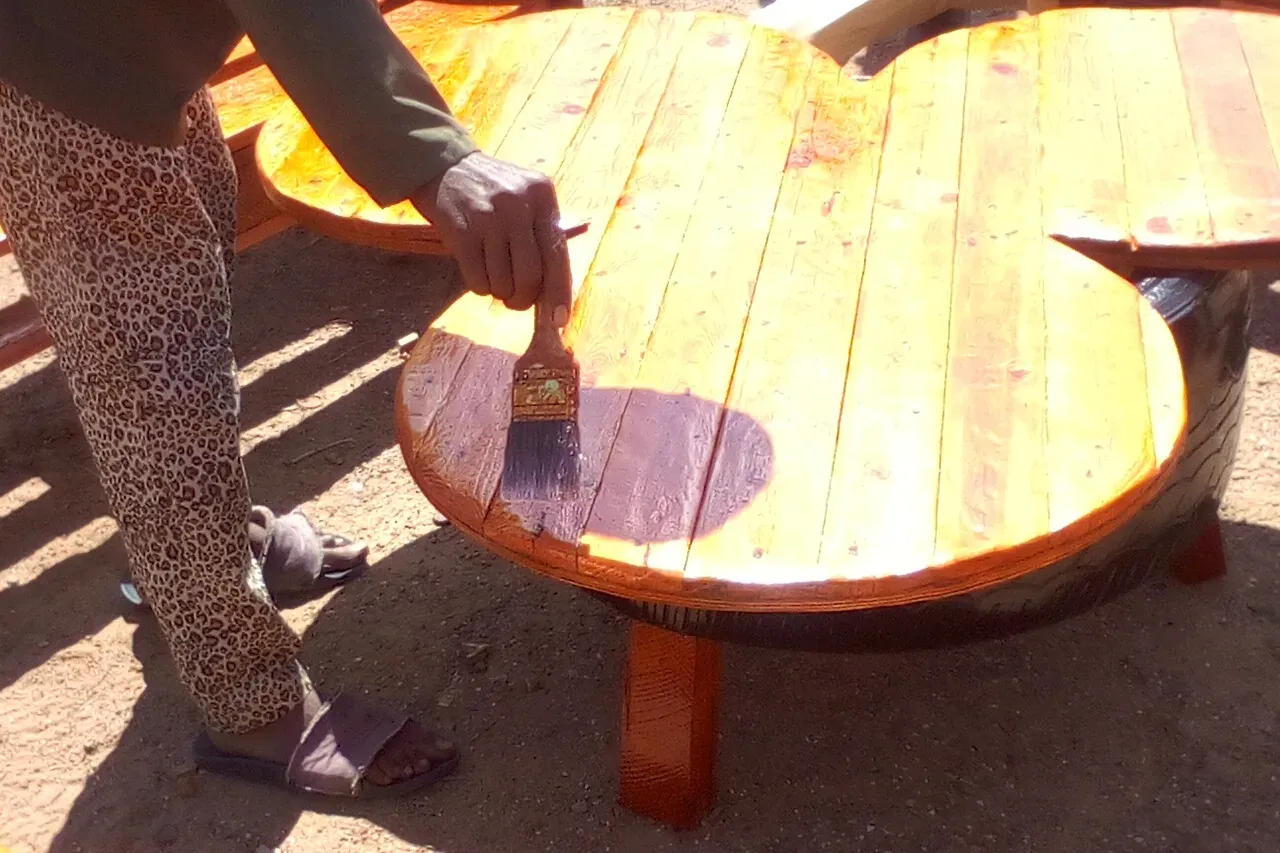
The photo is a table being varnished with a brush, from Wikimedia Commons. It isn’t my table or a test.
Where this comes from
- Bob Flexner, Popular Woodworking. Oil finishes: their history and use. Magazine article. Bob Flexner, Popular Woodworking Consulted 1 Nov 2026. back
- Bob Flexner, Popular Woodworking. Tinker toys, soccer balls and spaghetti. Magazine article. Bob Flexner, Popular Woodworking Consulted 1 Nov 2026. back
- Bob Flexner, Popular Woodworking. Polyurethane is almost always the best finish for wood floors. Magazine article. Bob Flexner, Popular Woodworking Consulted 1 Nov 2026. back
- Bob Flexner, Woodshop News. Testing wood finishes. Magazine column. Bob Flexner, Woodshop News Consulted 1 Nov 2026. back
- Chris A. Minick, Fine Woodworking. Wipe-on poly review. Magazine test (membership). Chris A. Minick, Fine Woodworking Consulted 1 Nov 2026. back
- Chris A. Minick, Fine Woodworking. Boiled linseed oil review. Magazine test (membership). Chris A. Minick, Fine Woodworking Consulted 1 Nov 2026. back
- Chris A. Minick, Fine Woodworking. Waterborne test results. Magazine test data (PDF). Chris A. Minick, Fine Woodworking Consulted 1 Nov 2026. back
- Popular Woodworking. Keep the hot sauce off the table: testing finish. Shop test, magazine blog. Popular Woodworking Consulted 1 Nov 2026. back
- Nancy Hiller, Popular Woodworking. Finish test follow-up: a surprise ending. Magazine blog. Nancy Hiller, Popular Woodworking Consulted 1 Nov 2026. back
- Craig Bentzley, Woodcraft. Finish test: water vs. oil. Retailer magazine test. Craig Bentzley, Woodcraft Consulted 1 Nov 2026. back
- Chris Marshall, Woodworker's Journal. Best coffee table finish?. Magazine Q&A. Chris Marshall, Woodworker's Journal Consulted 1 Nov 2026. back
- Family Handyman. How to stain and refinish a table top. Magazine article. Family Handyman Consulted 1 Nov 2026. back
- Minwax. Fast-Drying Polyurethane. Manufacturer page. Minwax Consulted 1 Nov 2026. back
- General Finishes. Arm-R-Seal oil based topcoat. Manufacturer page. General Finishes Consulted 1 Nov 2026. back
- Osmo. Polyx-Oil Original, product information. Manufacturer data sheet (PDF). Osmo Consulted 1 Nov 2026. back
- Petrilac. Lustrelac, para maderas en interiores (Spanish data sheet). Manufacturer data sheet (PDF). Petrilac Consulted 1 Nov 2026. back
- Petrilac. Lustrelac poliuretano (Spanish). Manufacturer page. Petrilac Consulted 1 Nov 2026. back
- Petrilac. Laca melacrílica (Spanish). Manufacturer page. Petrilac Consulted 1 Nov 2026. back
- Alba. Cristalba satinado (Spanish data sheet). Manufacturer data sheet (PDF). Alba Consulted 1 Nov 2026. back
- Cetol. Cetol Classic Balance (Spanish data sheet). Manufacturer data sheet (PDF). Cetol Consulted 1 Nov 2026. back
- Cetol. Parquet Balance satinado (Spanish). Manufacturer page. Cetol Consulted 1 Nov 2026. back
- Tersuave. Troya laca nitrocelulósica satinada (Spanish). Manufacturer page. Tersuave Consulted 1 Nov 2026. back
- Foromadera. Mesa de comedor de fresno (Spanish). Forum thread. Foromadera Consulted 1 Nov 2026. back
- Foromadera. Manchas en barniz (Spanish). Forum thread. Foromadera Consulted 1 Nov 2026. back
Changes in this guide
- First version.
Common questions
Which finish holds up best on a table?
In the tests I read, oil-based polyurethane came out on top for heat, stains and scratches. Bob Flexner says the same. Some water-based finishes matched it in Fine Woodworking's 2006 heat test and others came last.
Is oil OK on a dining table?
Boiled linseed oil alone protects little against water, according to Flexner and Fine Woodworking. A hardwax oil like Osmo is a different product: its data sheet claims resistance to wine, coffee and water, and in a Popular Woodworking test its stains disappeared on their own after three days.
What does lacquer mean on a can?
In the US it usually means nitrocellulose, which Flexner groups with the finishes that let more water through. In Argentina it depends on the can: Petrilac's Lustrelac is called a polyurethane lacquer for indoor furniture, while its melacrílica lacquer is for exteriors and the page says not to use it on tables.
How long before I can use the table?
Longer than the dry-to-touch time. Minwax gives 24 hours for light use, General Finishes 7 to 10 days, and Petrilac says final hardness comes at 8 to 10 days.
Have you finished a table?
No. This is what I read before doing it.