Why wooden tabletops crack, and how to attach one so it doesn't
Wood swells and shrinks across its width with the humidity. Screw or glue a top down rigidly and it splits. What the Wood Handbook, Fine Woodworking and Woodcraft say. I have not built a table.
Researched in November 2026. Reviewed . Next review: May 2027. 11 sources
Also in español
How I built this guide
Sources I read. Chapter 4 of the USDA Wood Handbook (2010); Garrett Hack (1995) and Bob Van Dyke (2016) in Fine Woodworking; Rain Noe in Core77 (2018); Joe Hurst-Wajszczuk and Paul Anthony at Woodcraft; Bill Hylton and Bob Flexner in Popular Woodworking; two Foromadera threads.
What I cross-checked. Which sources blame rigid attachment and which blame wet wood. The magazines point at the attachment; wet wood comes up in the forums.
What I could not verify. Woodcraft's 3/16 inch per foot rule, which I did not compare against a measurement. Hack's button sizes are in the readable part of his article; I did not read the rest of the PDF. No hardware prices.
A solid wood tabletop does not sit still. It swells when the air is humid and shrinks when it is dry, and it does most of that across its width. If something holds it rigidly, the wood wins and splits. I have not built a table. This is what I read so I don’t learn it on the first one.
The short answer
High confidence on the cause: the Wood Handbook, two magazines and two retailer guides agree. Medium on the measurements, which come from partly paywalled articles and a retailer's rule of thumb.
- Wood moves across its width, hardly at all along it. It shrinks most along the growth rings, about half as much across them, and very little along the grain.1
- The most cited cause is fastening the top with no room to move. Woodcraft says a top that is over-secured is doomed to shrink and crack.2 Garrett Hack says he has repaired many old tables with that problem.3
- The fix is to attach it with hardware that lets the top slide: wood buttons, figure-8 fasteners, Z-clips or elongated holes, and no glue between top and base.456
- A finish won’t do it for you. It slows moisture exchange, it does not stop it.78
You can estimate how much your top will move with the wood movement calculator and the moisture content calculator.
Why it happens
Wood takes water from the air or gives it back until it balances with the humidity and temperature around it. That balance shifts with the seasons.9 Below roughly 30% moisture content, every point lost shrinks the piece and every point gained swells it.10
An example with Wood Handbook numbers, run through the calculator on this site: a 500 mm (about 19 3/4 in.) flatsawn northern red oak top going from 7% to 12% moisture content grows about 7.7 mm, a little over 5/16 in. At 20 °C (68 °F) and 35% relative humidity, wood settles near 7%; at 25 °C (77 °F) and 70%, near 13%. The handbook warns that individual boards vary, with a coefficient of variation around 15%.11
If those millimeters have nowhere to go, something gives. In winter the top wants to shrink and it cracks. In summer it wants to grow and can push the base joints apart.12 Rain Noe at Core77 puts it this way: that movement cannot be restrained without the wood cracking.13
The cut matters too. Because wood shrinks about twice as much along the rings as across them, a flatsawn board tends to cup, and a quartersawn one moves less.14 Hack puts quartersawn movement at a bit under half.15
How to attach the top, per the magazines
Wood buttons. Hack’s preferred method. A small block with a tongue that fits a groove in the apron and a screw up into the top. He makes them about 3/4 in. thick, 1 in. wide and 1 1/2 to 2 in. long, in maple, birch or ash.16 Bob Van Dyke sets the button 1/16 in. below the top of the apron, so the screw pulls the top down tight.17 Woodcraft cuts them from a 3/4 by 1 in. hardwood strip.18
Figure-8 fasteners. A metal piece that pivots as the top moves. Woodcraft recommends them for tops under about 18 in. wide.1920
Z-clips. They sit in a saw kerf in the apron and allow more movement than figure-8s. Woodcraft gives the slot as 1/8 in. wide and 3/8 in. deep.21 On wide tops, Paul Anthony says to seat them fully in the humid season and back them off about 3/16 in. in the dry season.22
Screws in elongated holes. Hack elongates the hole in the direction of movement and uses a roundhead screw with a washer.23 Van Dyke points out that a plain pilot hole allows no movement at all: it has to be tapered so the screw can pivot.24
How many, and where. Hack fastens every 4 to 8 in. along the side aprons, starting near the legs, and uses about half as many on the front and back.25
Breadboard ends. If the top has breadboard ends across the grain, Bill Hylton uses little glue or none, one fixed peg at the center and the rest in elongated holes.26
What users say
On Foromadera, a Spanish-language forum, someone describes a rented table with a crack that grew over a few months. The replies split: wood that was wet when built, a cupped board forced flat during glue-up, and a top too thin for its length. Nobody measured the moisture, and the thread does not say how it ended.27
In another thread, a maker of pine tables says many of their tops crack or open at the glue line. Replies say the most common mistake is fixing the top so it cannot move, that poorly dried wood cracks, and that end grain should be sealed. He ended up switching to a supplier with drier wood. Whether that was enough is not reported.28
Where they disagree
Where the fixed point goes. Core77 fixes the top at two points on the centerline, so the overhang stays even on both sides.29 Hack fixes it at the front or the center.30 Van Dyke fixes the back edge.31 All three let the rest slide.
Wet wood or rigid fastening. The magazines and retailers point at the fastening. Poorly dried wood comes up in both forum threads, as user opinion.3233 The handbook explains the mechanism behind both: wood that dries after it is assembled shrinks just the same.34
Finishing both sides. One forum thread recommends it, along with polyurethane.35 Flexner writes that finishing both sides does no harm, but it does not stop cupping either.36
My take
If I build a table, the top gets screwed down with buttons or clips, never glued to the base, with a single fixed point. Before cutting, I would run the top’s width, the species and my home’s winter and summer humidity through the movement calculator, to know how much play to leave. And I would not expect the finish to do that job.
Gluing up the panel is covered in clamps for a first shop and the glue note.
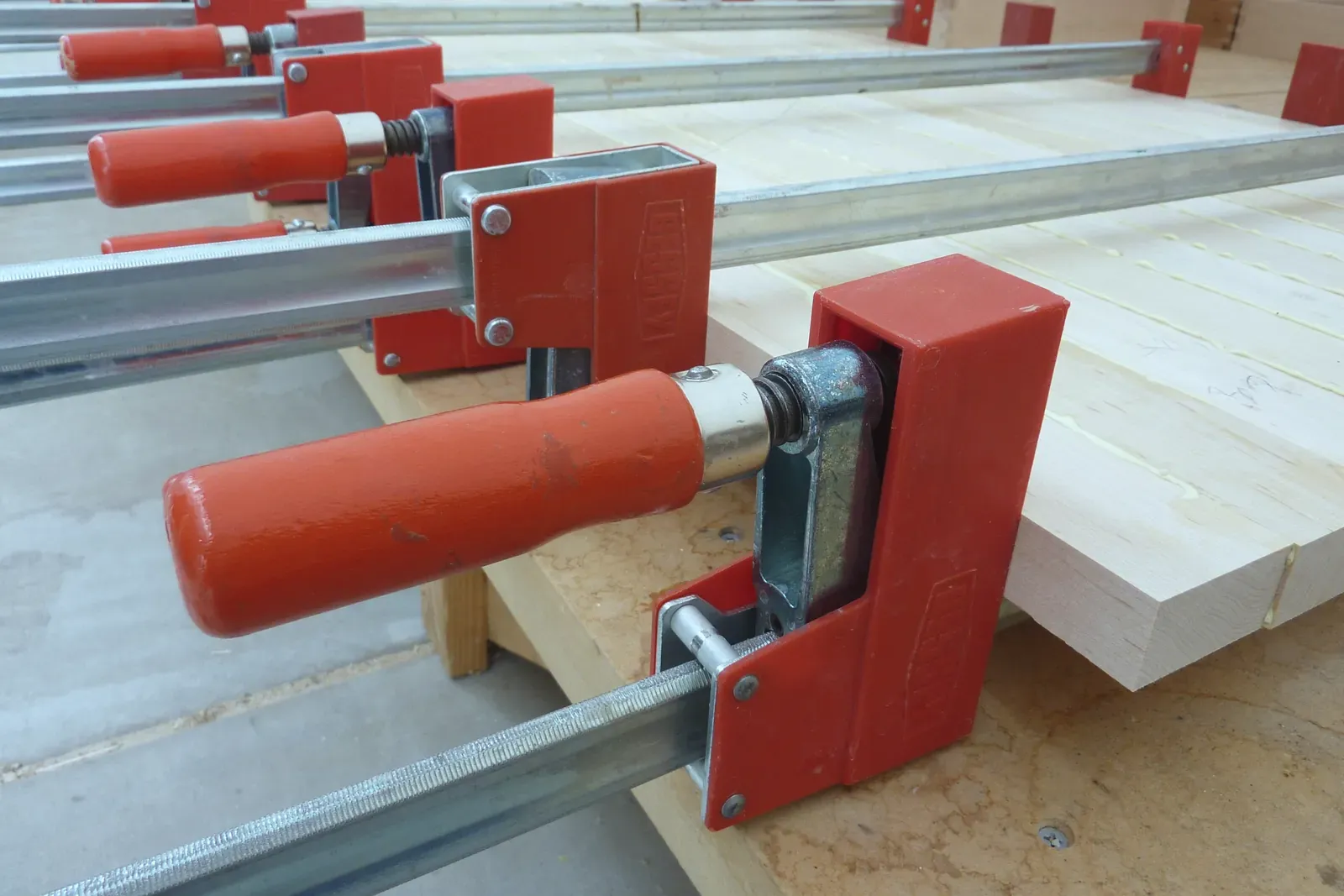
The photo is a maple panel glue-up from Wikimedia Commons. It is not a cracked top or a table of mine.
Where this comes from
- Samuel V. Glass and Samuel L. Zelinka, USDA Forest Products Laboratory. Moisture relations and physical properties of wood (Wood handbook, ch. 4, FPL-GTR-190). US government technical handbook. Samuel V. Glass and Samuel L. Zelinka, USDA Forest Products Laboratory Consulted 1 Nov 2026, in a reproduction of the chapter. back
- Garrett Hack, Fine Woodworking. 5 ways to attach tabletops. Magazine article (partly behind membership). Garrett Hack, Fine Woodworking Consulted 1 Nov 2026. back
- Bob Van Dyke, Fine Woodworking. Attaching solid-wood tabletops. Magazine article (partly behind membership). Bob Van Dyke, Fine Woodworking Consulted 1 Nov 2026. back
- Rain Noe, Core77. Designing for wood movement, part 1: the wrong way to build a tabletop or panel. Article. Rain Noe, Core77 Consulted 1 Nov 2026. back
- Rain Noe, Core77. Designing for wood movement, part 2: using cleats or buttons to attach a tabletop. Article. Rain Noe, Core77 Consulted 1 Nov 2026. back
- Joe Hurst-Wajszczuk, Woodcraft. How to attach a tabletop and allow for wood movement. Retailer guide. Joe Hurst-Wajszczuk, Woodcraft Consulted 1 Nov 2026. back
- Paul Anthony, Woodcraft. Tabletop fasteners. Retailer guide. Paul Anthony, Woodcraft Consulted 1 Nov 2026. back
- Bill Hylton, Popular Woodworking. How to make breadboard ends. Magazine article. Bill Hylton, Popular Woodworking Consulted 1 Nov 2026. back
- Bob Flexner, Popular Woodworking. Finish both sides: is it necessary to do this or not?. Magazine column. Bob Flexner, Popular Woodworking Consulted 1 Nov 2026. back
- Foromadera. Arreglo de mesa y por qué pasó esto? (Spanish). Forum thread. Foromadera Consulted 1 Nov 2026. back
- Foromadera. Mesas agrietadas (Spanish). Forum thread. Foromadera Consulted 1 Nov 2026. back
Changes in this guide
- First version.
Common questions
How much does a wooden tabletop move?
It depends on the species, the cut and how much the humidity swings. Woodcraft gives a rule of thumb of about 3/16 inch per foot of width. For your wood and your climate, use the wood movement calculator on this site, which works from Wood Handbook values.
Does finishing both sides stop a top from cracking?
Not according to what I read. The Wood Handbook says a finish slows moisture change but does not prevent it, and Bob Flexner writes that finishing both sides does not make a board less likely to cup.
Can a cracked top be fixed?
Forum members on Foromadera suggest regluing with clamps or adding butterfly keys underneath. That is forum advice and I do not know how it worked out. If the top stays rigidly fastened, the problem comes back.
Have you built a table this way?
No. This is what I read before building my first one.