Clamps for a first shop: which ones, and how many
Bar, pipe, parallel, one-handed and spring clamps, from Fine Woodworking, Woodsmith and Popular Woodworking. I have not glued up a panel with any of them.
Researched in October 2026. Reviewed . Next review: April 2027. 6 sources
Also in español
Research guide: I have not tested these products. Affiliate disclosure As an Amazon Associate I earn from qualifying purchases.
How I built this guide
Sources I read. Megan Fitzpatrick (2020), Jeff Miller (2016), the 2010 clamp-force piece and Tim Albers’ 2009 parallel clamp test, all Fine Woodworking; Bryan Nelson in Woodsmith (2020); David Thiel in Popular Woodworking (2005).
What I cross-checked. Which clamp a source says squeezes hardest, against which one it actually likes using. They are not the same clamp.
What I could not verify. Albers’ winners and Miller’s clamp counts, which sit behind the paywall. Forum debates on pipe versus parallel that I saw only as search snippets. No prices.
Most sources suggest this if buy two or three clamps for the glue-up you are about to do, and add more when a project asks; skip it if want one magic number of clamps, or a pressure figure that does not depend on whose hands turned the handle.
As an Amazon Associate I earn from qualifying purchases.
3/4 in pipe clamp fixtures
Budget. More than one source agrees.
Fitzpatrick calls pipe clamps inexpensive and wants 3/4 in pipe, not 1/2 in. Woodsmith says the heads fit standard black iron pipe and a coupler adds reach. Fine Woodworking measured a 3/4 in pipe clamp at 1,050 lb on average.
Heavy, small jaws, and raw iron can stain oak. Use pads.
Opens Amazon. Price and stock change. I have not used this. Affiliate link: if you buy, I may earn a commission. You do not pay more.
Jet parallel clamp
Not priced in my sources. More than one source agrees.
Fitzpatrick prefers the Jets for the faceted handle. Albers found the Jet trigger lock worked well. Thiel dropped them from bench height in Popular Woodworking and the plastic did not crack.
Parallel clamps gave the least force of five types in Fine Woodworking’s measurement.
Opens Amazon. Price and stock change. I have not used this. Affiliate link: if you buy, I may earn a commission. You do not pay more.
Bessey K Body parallel clamp
Not priced in my sources. The sources disagree. Read the notes in the guide.
Fitzpatrick names Bessey and Jet as the two big makers of this style and says either is fine for most jobs. Albers included Bessey in his six-maker test. His verdict is behind the paywall.
Least force in one measurement. Albers says force is not why you buy one.
Opens Amazon. Price and stock change. I have not used this. Affiliate link: if you buy, I may earn a commission. You do not pay more.
F-style bar clamps
Not priced in my sources. More than one source agrees.
Woodsmith calls them the foundation of almost any shop and says heavy-duty ones with Acme threads resist flex. Miller calls bar clamps the core of a clamp kit.
Fitzpatrick mostly uses them to hold work to the bench, not for big glue-ups.
Opens Amazon. Price and stock change. I have not used this. Affiliate link: if you buy, I may earn a commission. You do not pay more.
Quick-Grip one-handed clamp
Not priced in my sources. More than one source agrees.
Fine Woodworking measured a Quick-Grip at 470 lb on average, more than the parallel clamp. Fitzpatrick keeps a handful to hold parts while a stronger clamp goes on.
Fine Woodworking’s red oak example needed 26 of them.
Opens Amazon. Price and stock change. I have not used this. Affiliate link: if you buy, I may earn a commission. You do not pay more.
I do not own a clamp worth naming. I have not glued up a panel. This is what I read before buying the first ones, so I buy for a project and not for a wall.
The short answer
Medium. Four Fine Woodworking pages, two of them partly paywalled, plus Woodsmith and Popular Woodworking. They agree on what each clamp is for. None gives a beginner a number.
- Bar clamps are the core. Jeff Miller calls them the shop workhorse, for panels, carcases and chairs.1 Woodsmith calls F-style bar clamps the foundation of almost any shop.2
- Pipe clamps are the cheap way to get length. The heads fit ordinary black iron pipe, and a coupler adds reach.3 Megan Fitzpatrick says use 3/4 in pipe, because 1/2 in is not rigid enough for big work.4
- Parallel jaw clamps sit flat and keep parts square. They are Fitzpatrick’s workhorse.5 They were also the weakest squeeze in one Fine Woodworking measurement.6
- One-handed and spring clamps mostly hold things. Fitzpatrick uses one-handed clamps to keep parts in place while a stronger clamp goes on.7
How many: buy for the glue-up in front of you. Fine Woodworking shows how to count it, further down.
What the experts say
Fitzpatrick lists her clamps in the order she uses them. Parallel jaw clamps, often called K-body, come first. They sit flat for panels, and she owns twelve in one length. Old iron bar clamps give more pressure but are heavy. Pipe clamps are inexpensive, heavy, and have small jaws. Raw iron can stain oak, so she suggests pads. F-style clamps mostly hold work to her bench. Many spring clamps, she finds, are hard to work with one hand, and the easy ones grip only a little.8 She also says she builds large pieces, so your needs may differ. That sentence matters for a first shop.
Fine Woodworking’s editors measured what each clamp type delivered, with a jig and bathroom scales. On average, the parallel jaw clamp gave 370 lb, a Quick-Grip 470 lb, an aluminum bar clamp 680 lb, a 3/4 in pipe clamp 1,050 lb and an I-beam bar clamp 1,350 lb. The person turning the handle changed the result a lot.9
Tim Albers tested parallel clamps from six makers. In the part I could read without a membership, the case for them is not pressure. Pipe and I-beam clamps, he says, already have more than enough. It is big jaws that dent the work less, and jaws square to the bar so parts do not slide. He also found some jaws slide down too easily when the clamp is held upright.10
David Thiel’s Popular Woodworking review dropped Jet’s parallel clamps from bench height. The plastic scuffed and did not crack.11
What owners report
I did not open an owner thread I would quote. Pipe versus parallel debates showed up as search snippets only, so they are not sources here. Under the Fine Woodworking force piece, a reader says a video showed lower pressure works on well-prepared edges. That is a comment, not a test.
Where they disagree
“You can never have too many clamps.” Miller opens with it and calls it true. Then he says buy for the main work you do, on a finite budget.12 Fitzpatrick adds the catch: you can have too many useless ones.13 Paul Sellers is often quoted against the saying. His page did not load for me, so I am not putting words in his mouth.
Pressure is the other split. Fitzpatrick’s workhorse is the parallel clamp. The measurement put it last, behind even the Quick-Grip.14 Albers says force is not why you buy one.15 Both can be true. On aluminum bar clamps, Woodsmith likes the lighter weight.16 Fitzpatrick says they bend easily.17
How many, for a real project
Fine Woodworking’s method: find the area of one glue surface, multiply by the pressure that wood wants, then divide by what one clamp gives. Their flatsawn pine example needed three 3/4 in pipe clamps. The same area in quartersawn maple needed nine. For two red oak boards 36 in long, they estimated about nine heavy bar clamps, a dozen pipe clamps or 26 quick-grip clamps, and said mixing types is fine.18
So the count comes from the wood and the joint, not from a list.
My take
My first glue-up will be the cutting board. That points me at a few long clamps that really squeeze. Pipe clamps if the budget is thin, with pads against the stain. Parallel clamps are the flat, square upgrade I would add when a panel or a box asks for it. A couple of one-handed clamps for holding parts. Spring clamps when a jig needs one.
How long the clamps stay on is the glue’s call, on the bottle and in the glue note. Something solid to clamp against is the workbench note.
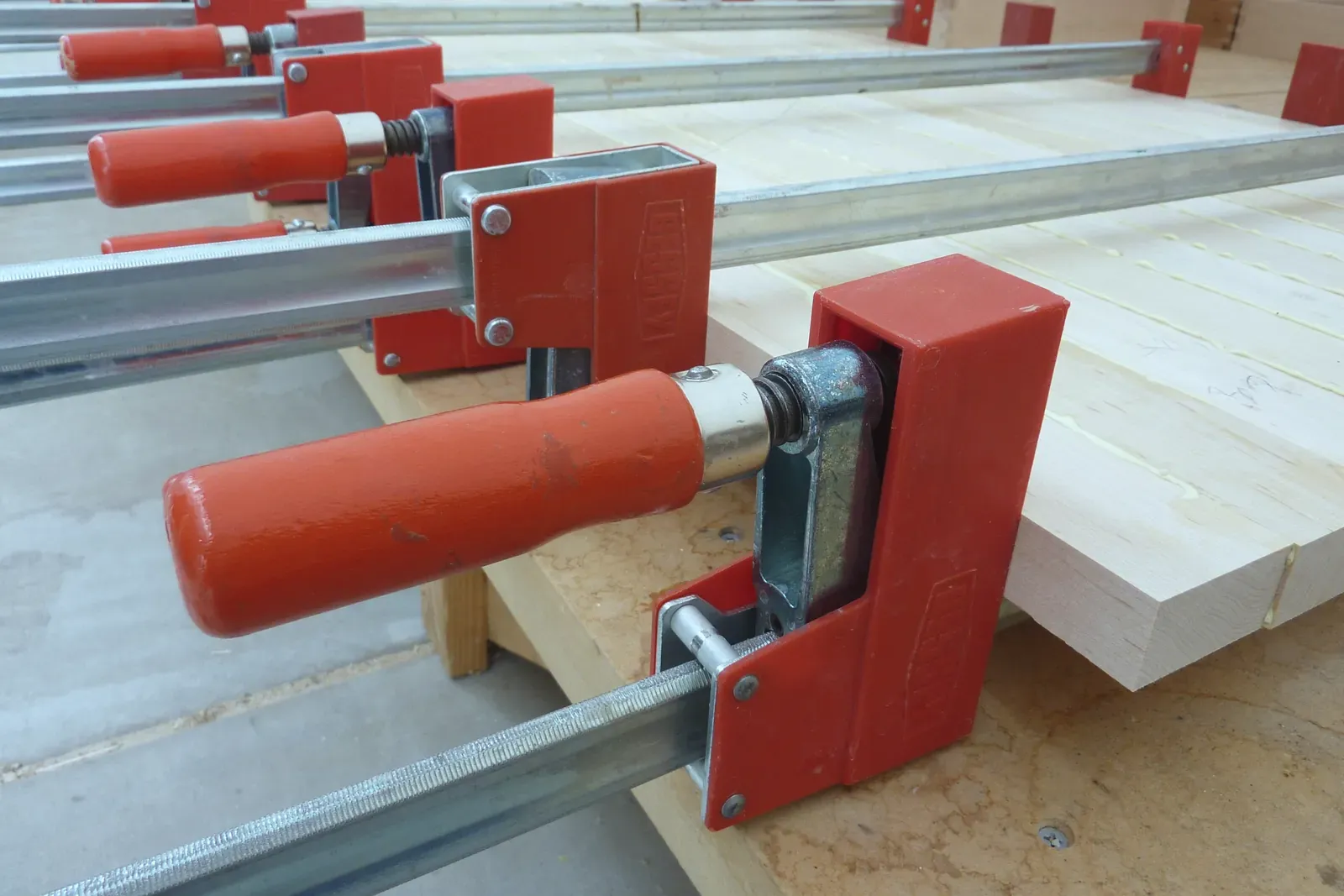
The photo is a glue-up from Wikimedia Commons. It is not my bench and not a pick.
Where this comes from
- Megan Fitzpatrick, Fine Woodworking. The woodworking clamps you need. Magazine essay. Megan Fitzpatrick, Fine Woodworking Consulted 31 Oct 2026. back
- Jeff Miller, Fine Woodworking. Essential clamp kit. Magazine article (partly paywalled). Jeff Miller, Fine Woodworking Consulted 31 Oct 2026. back
- Fine Woodworking editors. How to glue-up joints: the right number of clamps. Shop test. Fine Woodworking editors Consulted 31 Oct 2026. back
- Tim Albers, Fine Woodworking. Who makes the best parallel clamp?. Comparative test (partly paywalled). Tim Albers, Fine Woodworking Consulted 31 Oct 2026. back
- Bryan Nelson, Woodsmith. The essential clamps every woodworker needs. Guide. Bryan Nelson, Woodsmith Consulted 31 Oct 2026. back
- David Thiel, Popular Woodworking. Tool test: Jet parallel jaw clamps. Review. David Thiel, Popular Woodworking Consulted 31 Oct 2026. back
Changes in this guide
- First version.
Common questions
How many clamps do I need to start?
No page I opened gives a beginner a number. Fine Woodworking gives a way to count instead: glue area times the pressure the wood wants, divided by what one clamp delivers. In their flatsawn pine example that came out at three 3/4 in pipe clamps.
Are parallel clamps worth it?
Megan Fitzpatrick and Tim Albers like them for flat, square jaws that dent less. In one Fine Woodworking measurement they gave the least force of five types. Worth it for panels and boxes, by those sources. Not for raw squeeze.
Are the clamps in the photo a recommendation?
No. The photo is a maple glue-up with red-handled bar clamps from Wikimedia Commons. I do not know the brand, and it is not one of the picks.