How to stain pine without blotching
Pine soaks up stain unevenly. Conditioner, a thin washcoat or gel stain: what Bob Flexner, Fine Woodworking, Minwax and General Finishes say, and where they contradict each other. I have not stained pine.
Researched in November 2026. Reviewed . Next review: May 2027. 14 sources
Also in español
How I built this guide
Sources I read. Bob Flexner (2007 and 2023), Kevin Southwick (2020) and Tim Johnson (2022) in Popular Woodworking; Teri Masaschi and Joshua Klein in Fine Woodworking; Greg Williams in Woodshop News; Family Handyman; a test by The Wood Whisperer; the Minwax and General Finishes conditioner pages; two Foromadera threads.
What I cross-checked. The wait between conditioner and stain on each label, against the wait Flexner asks for. They don't match, and that gap is the core of this note.
What I could not verify. Southwick's sealing percentages are his estimates, not measurements. The Wood Whisperer's test is one shop, and the product that won is a brand. No prices.
Pine is the easiest wood to find at a lumberyard and the worst at taking stain. It ends up with dark patches wherever the wood is softer. I have not stained pine yet. This is what I read, and the most useful part is that the people selling conditioner and the people writing about finishing don’t say the same thing.
The short answer
High confidence on the cause, and that any method lightens the color. Medium on which method to use, because the sources contradict each other and almost nobody publishes a test.
- Blotching comes from uneven density. The more porous parts take more stain.1 Pine is on every list of difficult woods.234
- Always test on an offcut of the same wood. Masaschi, Johnson, Family Handyman and Southwick all ask for it.5678
- There are three routes: a conditioner or very thin finish before the stain, a gel stain that penetrates less, or a water-based dye in several diluted coats.91011
- They all lighten the color. The more you control the blotch, the lighter the tone.1213
Why it happens
Flexner defines blotching as uneven coloring caused by uneven densities in the wood. He names pine, spruce, fir, aspen, poplar and alder as bad blotchers, and oak, ash and mahogany as woods that don’t tend to blotch.14 Tim Johnson adds that in pine the stain goes into the softer earlywood and not the dense latewood lines: the grain reverses, light turning dark and dark turning light.15
Kevin Southwick says stains with black or dark pigment, even a little, usually blotch worst, and light golden ones least.16 To see where it will blotch before you start, he wipes the wood with paint thinner: the areas that darken are the trouble spots.17
The methods, one at a time
Commercial conditioner. Flexner says most are one part varnish thinned with about two parts mineral spirits, the same as a thinned varnish washcoat.18 The labels:
- Minwax oil-based: sand with 220 grit, apply, let it penetrate 5 to 15 minutes, wipe off the excess and stain within 2 hours.19
- Minwax water-based: let it penetrate 1 to 5 minutes, wipe, sand lightly after 15 to 30 minutes, then stain per the stain’s label.20
- General Finishes oil-based: let it penetrate 10 minutes or more, wipe, and stain after 30 minutes but before 2 hours, never the next day. It warns the color comes out lighter and you may need a darker stain.21
Shellac washcoat. Teri Masaschi, in Fine Woodworking, applies one before the color: premixed shellac, which she says is a 3-lb. cut, mixed 3 parts to 2 with denatured alcohol for about a 1-lb. cut.22 Greg Williams uses the same strength.23 Flexner wants it thinner still.24 At The Wood Whisperer, two coats of shellac stopped the blotching but let almost no color in.25
Gel stain. It is thickened stain. Because it flows less into the wood, it blotches less.26 Joshua Klein, in Fine Woodworking, suggests diluted dyes or gel stains that don’t penetrate as deep.27 Family Handyman says gel sits on top of the surface rather than in it.28
Water-based dye in diluted coats. Williams calls several coats of reduced dye probably the safest approach.29 Johnson builds a whole system for pine: water-based conditioner, water-soluble powdered dye, shellac and an oil glaze. He sands to 220, wets the wood to raise the grain and goes over it with 400.30
Sanding. General Finishes warns that over-sanding with fine grits closes the wood, and asks for no finer than 180 on closed-grain wood with its oil-based conditioner.31 Williams puts the final grit between 150 and 320, and says to stain soon: a sanded surface in high humidity can stain differently within a few hours.32 Grits are covered in the sanding grits guide.
If the pine comes from a glue-up, glue left on the surface won’t take stain either. That’s in how to glue up a tabletop.
What users say
On Foromadera, a Spanish-language forum, one member says pine is very porous and doesn’t absorb evenly, and suggests a heavily thinned sealer or sanding fine. Another prefers to add the tint to the sealer or the varnish, rather than staining bare wood.33
In another thread, members contradict each other. One says you shouldn’t put anything on before the stain. Another recommends a homemade conditioner: about 50 ml of varnish to 250 ml of solvent, 6 hours to dry, then the stain.34 These are user opinions, mostly from Spain.
Where they disagree
Whether conditioner works. Minwax and General Finishes say it evens out color on pine.3536 Flexner wrote in 2007 that the Minwax and Olympic directions are wrong for eliminating blotching,37 and in 2023 that woodworkers would probably be better off if conditioners were taken off the market.38 Southwick estimates commercial ones seal only about 10 to 15% of the wood.39
How long to wait before staining. This is the most concrete gap:
| Source | Wait between conditioner and stain |
|---|---|
| Minwax oil-based | within 2 hours |
| General Finishes oil-based | between 30 minutes and 2 hours |
| Flexner, 2007 | overnight for varnish-based; 30 minutes to an hour for water-based |
| Flexner, 2023 | at least 6 hours for varnish-based |
Table sources: Minwax,40 General Finishes41 and Flexner in 200742 and 2023.43
For Flexner, after 2 hours the stain mixes with conditioner that is still liquid, and the wood blotches anyway.44
Whether gel fixes it. Flexner says gel works better than conditioner.45 Southwick says it helps only somewhat.46
Shellac or a commercial product. Masaschi and Williams use shellac.4748 Southwick says it dries too fast to apply evenly as a blotch controller.49 The Wood Whisperer preferred a branded conditioner to shellac in its test.50
My take
If I stain pine, I start with an offcut from the same board, split into three: nothing, conditioner or thinned varnish left to dry properly, and gel stain. I choose with the dry sample in my hand, not the picture on the can. And I accept that any method will come out lighter than the label.
If what you want is even pine rather than dark pine, maybe skip the stain. Which clear finish to use is for the varnish, lacquer or oil guide.
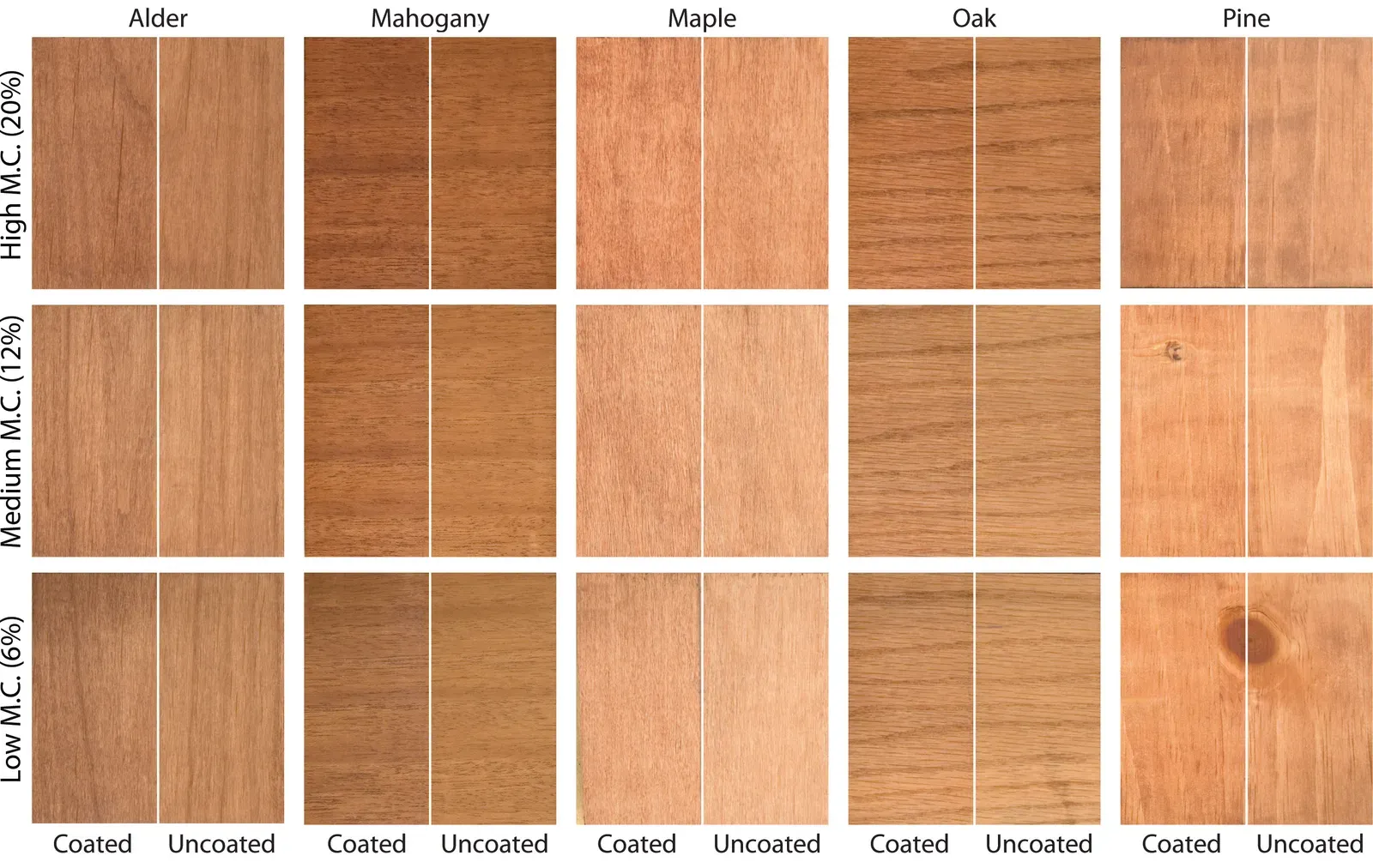
The photo shows stain samples on five woods, from Wikimedia Commons. The file page doesn’t say what coating is on the halves labeled coated. It is not a test of mine.
Where this comes from
- Bob Flexner, Popular Woodworking. Battling blotching. Magazine article. Bob Flexner, Popular Woodworking Consulted 1 Nov 2026. back
- Bob Flexner, Popular Woodworking. Sealers & washcoats. Magazine article. Bob Flexner, Popular Woodworking Consulted 1 Nov 2026. back
- Kevin Southwick, Popular Woodworking. How to control blotching. Magazine article. Kevin Southwick, Popular Woodworking Consulted 1 Nov 2026. back
- Tim Johnson, Popular Woodworking. How to stain pine. Magazine article. Tim Johnson, Popular Woodworking Consulted 1 Nov 2026. back
- Teri Masaschi, Fine Woodworking. Avoid color mistakes and learn how to fix a blotchy stain. Magazine article (membership banner). Teri Masaschi, Fine Woodworking Consulted 1 Nov 2026. back
- Joshua A. Klein, Fine Woodworking. Fine pine finishes. Magazine note (membership banner). Joshua A. Klein, Fine Woodworking Consulted 1 Nov 2026. back
- Greg Williams, Woodshop News. Avoid a blotch on your finishing record. Magazine column. Greg Williams, Woodshop News Consulted 1 Nov 2026. back
- Family Handyman, with George Crew. How to stain wood evenly without getting blotches and dark spots. Magazine article. Family Handyman, with George Crew Consulted 1 Nov 2026. back
- The Wood Whisperer. Blotch control to rule them all. Shop test. The Wood Whisperer Consulted 1 Nov 2026. back
- Minwax. Pre-Stain Wood Conditioner. Manufacturer page. Minwax Consulted 1 Nov 2026. back
- Minwax. Water-Based Pre-Stain Wood Conditioner. Manufacturer page. Minwax Consulted 1 Nov 2026. back
- General Finishes. Oil based pre-stain wood conditioner. Manufacturer page. General Finishes Consulted 1 Nov 2026. back
- Foromadera. Teñir madera de pino (Spanish). Forum thread. Foromadera Consulted 1 Nov 2026. back
- Foromadera. Tenir y barnizar madera de pino (Spanish). Forum thread. Foromadera Consulted 1 Nov 2026. back
Changes in this guide
- First version.
Common questions
Why does pine blotch when stained?
Because its density is uneven. The more porous areas soak up more stain than the hard ones and come out darker. Bob Flexner defines blotching that way and lists pine among the worst offenders.
Does pre-stain wood conditioner work?
The manufacturers say yes. Bob Flexner says that, used as the label directs, it barely helps, because the wait it gives before staining is too short. In his view gel stain works better.
How long should I wait between conditioner and stain?
Minwax's oil-based label says to stain within 2 hours. General Finishes says between 30 minutes and 2 hours. Flexner asks for overnight, or at least 6 hours, for a varnish-based conditioner.
Can blotchy pine be fixed?
Flexner says it is the one problem stripping won't fix: you have to sand or plane off as much as 1/32 in. Masaschi, in Fine Woodworking, hides mild blotching with a shellac washcoat and a brown glaze.
Have you stained pine?
No. This is what I read before doing it.