Sanding grits, without inventing a scratch depth
P means FEPA. A Fine Woodworking test stopped most bare wood at P150 or P220. I have not sanded a panel to check.
Researched in October 2026. Reviewed . Next review: April 2027. 3 sources
Also in español
Research guide: I have not tested these products. Affiliate disclosure As an Amazon Associate I earn from qualifying purchases.
How I built this guide
Sources I read. Fine Woodworking’s True Grit (2005) and Jeff Tuckman’s When to Stop Sanding.
What I cross-checked. That CAMI and FEPA stay close through about 220, and that the stop-sanding test names P150 and P220.
What I could not verify. Stain. Tuckman says he did not test stain, softwood, or very hard tropical woods.
Most sources suggest this if you are sanding bare wood for a clear film or an oil; skip it if you are staining, or you think a higher number is always finer across both scales.
As an Amazon Associate I earn from qualifying purchases.
FEPA aluminum-oxide sheets
Budget. One source, no second opinion.
Fine Woodworking’s grit article treats the P prefix as the FEPA scale. A later FWW test stopped bare wood at P150 for film finish and P220 for oil.
That stop-sanding test was not softwood and not stain.
Opens Amazon. Price and stock change. I have not used this. Affiliate link: if you buy, I may earn a commission. You do not pay more.
The number on the back of the sheet is a scale, not a promise. I have not run a grit sequence. Which sander to buy is here. Whether to scrape instead is here.
Two scales
High that the P matters. Medium on where you stop. One article explains the scales. One test, on three furniture woods and clear finish, suggests a stopping point.
Mark Schofield, in Fine Woodworking, separates CAMI (a plain number: 180, 220) from FEPA (a P: P180, P220). He writes that below 220 the particle size for a given number is almost the same, and that the finer the grit, the more the scales diverge. To match CAMI 600 he says you may need FEPA P1000 or P1200. In the grits people use on bare wood, about 80 to 150, he says FEPA paper is slightly coarser than the CAMI number and cuts a bit faster, with a more uniform scratch because the particles sit closer to the stated size.1
Jeff Tuckman then sanded with FEPA aluminum oxide, P120 through P600, on three woods, and put on clear finishes. His result, in his words as printed: P150 if you are using a film finish, P220 for an oil on wood that does not blotch, and probably P400 on blotch-prone boards. He says wood sanded finer takes less stain, and that he did not test stain, softwoods, or very hard tropical woods. He also says the coarse grit still has to remove planer and jointer ripple, and that after a random-orbit sander you hand-sand with the grain to clear swirls.2
What I will not invent
I am not printing a micron table from memory. Schofield’s point is enough: read the P. Skipping from 80 to 220 leaves the 80-grit scratch; that is why his range is a sequence, not a single sheet. I have not measured a scratch.
My take
For a clear finish on ordinary furniture wood, the test I can cite stops earlier than the habit of sanding to 400. Film: P150. Oil, wood that does not blotch: P220. Read the back of the disc before you mix a no-P 320 with a P320 and assume they match. The finish on a food board is a different problem, here.
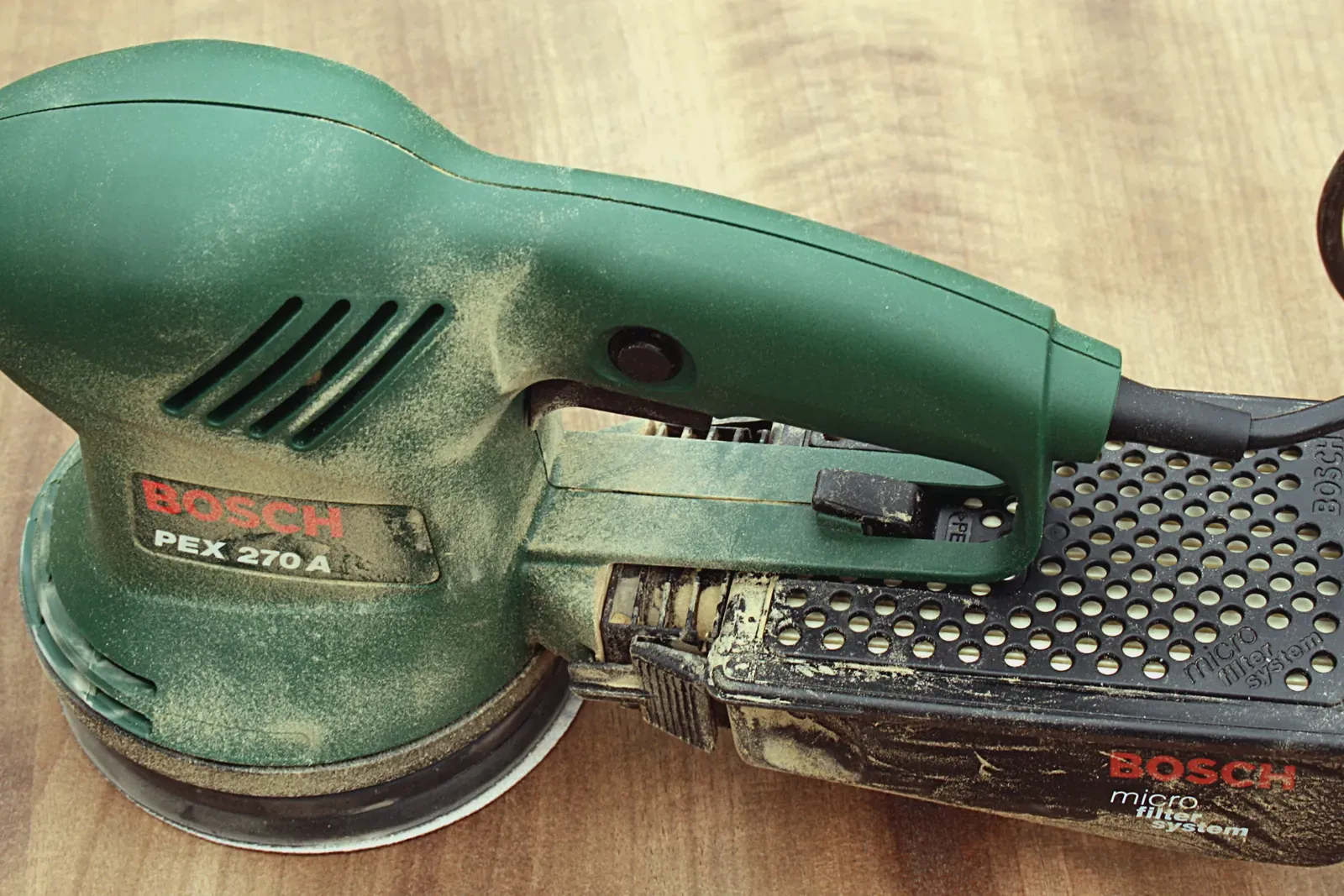
The sander in the photo is a Bosch PEX 270 A. It is not the model in the buying note.
Where this comes from
- Mark Schofield, Fine Woodworking. True Grit. Magazine article. Mark Schofield, Fine Woodworking Consulted 29 Oct 2026. back
- Jeff Tuckman, Fine Woodworking. When to Stop Sanding?. Magazine test. Jeff Tuckman, Fine Woodworking Consulted 29 Oct 2026. back
- Veta. How to choose a random-orbit sander. This notebook. Veta 29 Oct 2026. back
Changes in this guide
- First note. Choosing a sander is a different page.
Common questions
Is P220 the same as 220?
Schofield writes that below about 220 the particle sizes are almost the same, and that the scales diverge as the grits get finer. A bare 220 and a P220 are close. A 600 and a P600 are not.
Do I sand to 400 before finish?
Not as a rule from this test. Tuckman stopped at P150 for a film finish and P220 for oil on wood that does not blotch, and he used P400 only where blotching worried him. He did not test stain.