How to glue up boards for a tabletop, and how long to leave the clamps on
Picking and arranging boards, glue, clamps and clamp times from Titebond, two Argentine PVA glues, Fine Woodworking and Popular Woodworking. I have not glued up a panel.
Researched in November 2026. Reviewed . Next review: May 2027. 18 sources
Also in español
How I built this guide
Sources I read. Titebond spec sheets and its FAQ page; PVA glue sheets from Casco and Petrilac (Argentina); Christian Becksvoort, the Fine Woodworking editors and Hendrik Varju in Fine Woodworking; Christopher Schwarz and Robert W. Lang in Popular Woodworking; Ken Burton at Woodcraft; Woodworker's Journal; Family Handyman; Tom Caspar; a test on woodgears.ca; two Foromadera threads.
What I cross-checked. Each sheet's clamp time side by side. The Argentine sheets ask for far longer than Titebond, and I found nobody who explains why.
What I could not verify. I did not check Fine Woodworking's clamping pressure chart against another independent source. The woodgears.ca test is one shop, not peer reviewed. I found no published sheets with times for the Fischer or Akapol glues. No prices.
Most lumberyards sell planed boards narrower than a tabletop, so you join them edge to edge. I have not glued up a panel yet. This is what I read, with one surprise: the glue sheets do not agree on how long to leave it clamped.
The short answer
High confidence on the steps, which several magazines agree on. Low on clamp times, because each manufacturer says something different and I found no one who explains why.
- Pick boards for grain and color, and mark the order. Family Handyman wants similar boards, the best face up, and a V drawn across all of them so the order isn’t lost.1
- The edges should meet along their whole length. Schwarz leaves at most a tiny gap in the middle, one that closes with hand pressure.2
- Glue one joint at a time and add clamps wherever no glue squeezes out.3
- You don’t need to crank down hard. Robert Lang says it doesn’t take much pressure.4 A woodgears.ca test found weaker joints when clamped hard.5
- Your glue sets the clamp time, and it runs from 30 minutes to nearly 3 hours depending on the sheet.678
Step by step, per the sources
Pick and arrange. Lang picks boards for tabletops by appearance.9 Family Handyman also suggests flipping boards end for end.10 Whether to alternate growth rings is the argument further down.
Prepare the edges. Lang runs each edge over the jointer just before gluing, alternating faces against the fence to cancel out any error in it.11 Christopher Schwarz leaves a hairline gap in the middle of the seam, a spring joint: about .004 to .006 in., closed by hand. With it he uses one or two clamps on a 48 in. panel instead of about five.12
Glue. Family Handyman runs a 1/8 to 3/16 in. bead along the edge of one board and aims for an even 1/16 in. bead of squeeze-out.13 Lang doesn’t glue both boards or spread it either.14 Schwarz does spread a thin film.15 Titebond wants glue, air and wood above 50 °F (10 °C) for Original;16 Casco says not to glue below 10 °C (50 °F) ambient.17
Clamps. Fine Woodworking alternates clamps above and below the panel so it doesn’t bow.18 Schwarz puts the first clamp in the center.19 To keep the panel flat, the magazine adds hardwood cauls about 1 by 2 in., covered in tape so they don’t stick. One pair at each end, and another in the middle if the panel is longer than about 2 ft. Tighten the cauls first, then the clamps.20
Squeeze-out. Lang scrapes it off, then wipes with a damp rag.21 Tom Caspar removes it while it is still soft, and warns that stain won’t go through a glue film: you get a light patch.22 Family Handyman waits about 20 minutes, until it is like jelly, and scrapes it.23
When to unclamp and when to plane. Lang takes the clamps off after an hour and waits overnight before surfacing.24 Titebond says not to stress a new joint for at least 24 hours.25
After that, the top should not be screwed rigidly to the base. That is in why wooden tabletops crack.
What users say
On Foromadera, a Spanish-language forum, someone is about to glue pine boards into a top 3.20 m by 60 cm. Members recommend white glue with biscuits or dowels, a clamp every 70 cm or closer, gluing on a flat surface with battens to stop bowing, not overtightening, and waiting 24 hours before sanding. It is the only clamp spacing I found, and it comes from a user.26
In another thread, one member says that glue alone eventually leaves small steps between boards, and prefers a loose tongue. Another answers that with properly dried wood, glue is enough.27
Where they disagree
How long to clamp. This is the biggest gap, and I can’t explain it:
| Glue | Clamp time on the sheet |
|---|---|
| Titebond (most of its glues) | 30 minutes to 1 hour, unstressed joint |
| Casco 1002 | 180 min at 10–15 °C, 120 at 15–25 °C, 90 at 25–30 °C, 60 at 30–35 °C, then 6 hours of rest |
| Petrilac | about 2 1/2 hours |
Table sources: Titebond,28 Casco29 and Petrilac.30
The Argentine sheets talk about a press and a stack, as if written for a shop with a press. I don’t know whether the number changes for a panel in bar clamps. Until I do, I follow the bottle I bought.
Alternating growth rings. In Woodworker’s Journal, Rob Johnstone says to alternate them, and Michael Dresdner says it won’t stop each board moving but reduces the overall cup.31 Christian Becksvoort says there’s no need: he faces the best side out and has glued 12 in. boards into tops for 40 years.32 Schwarz says nobody can convince him there’s an advantage.33 Ken Burton sits in between: all one way, the panel curls like a potato chip; alternated, it ripples. He alternates only when a panel is unsupported, like a table leaf; on a frame he arranges for grain.34
Biscuits and dowels. Popular Woodworking says a good glue joint is stronger than the wood around it and needs no reinforcement.35 Schwarz agrees for panels 3 to 4 ft long, but on tops 6 ft or more he uses them for alignment, not strength.36 Fine Woodworking says much the same for panels wider than about 30 in., where cauls work less well.37
How much pressure. Titebond gives 100–150 psi for softwoods and 175–250 for hardwoods.38 A Fine Woodworking chart asks for far more, for example 600 to 1,200 psi for maple, and admits ordinary clamps can’t get there and the joint is strong anyway.39 On the other side, woodgears.ca broke more than 20 maple joints, and the ones clamped hard came out up to 20% weaker.40 That is one shop’s test.
My take
When I glue up my first top, I’ll arrange the boards by looks, since it will sit on a frame. First a dry run with the clamps set; that one is mine, none of the pages I read spell it out. Then one joint at a time, clamps alternated, cauls, and no tightening to the point of crushing. Squeeze-out off before it hardens. And the clamp time from the sheet of the glue in my hand, plus a night before planing.
Which clamps and how many is in clamps for a first shop. What each Titebond bottle says is in wood glue types.
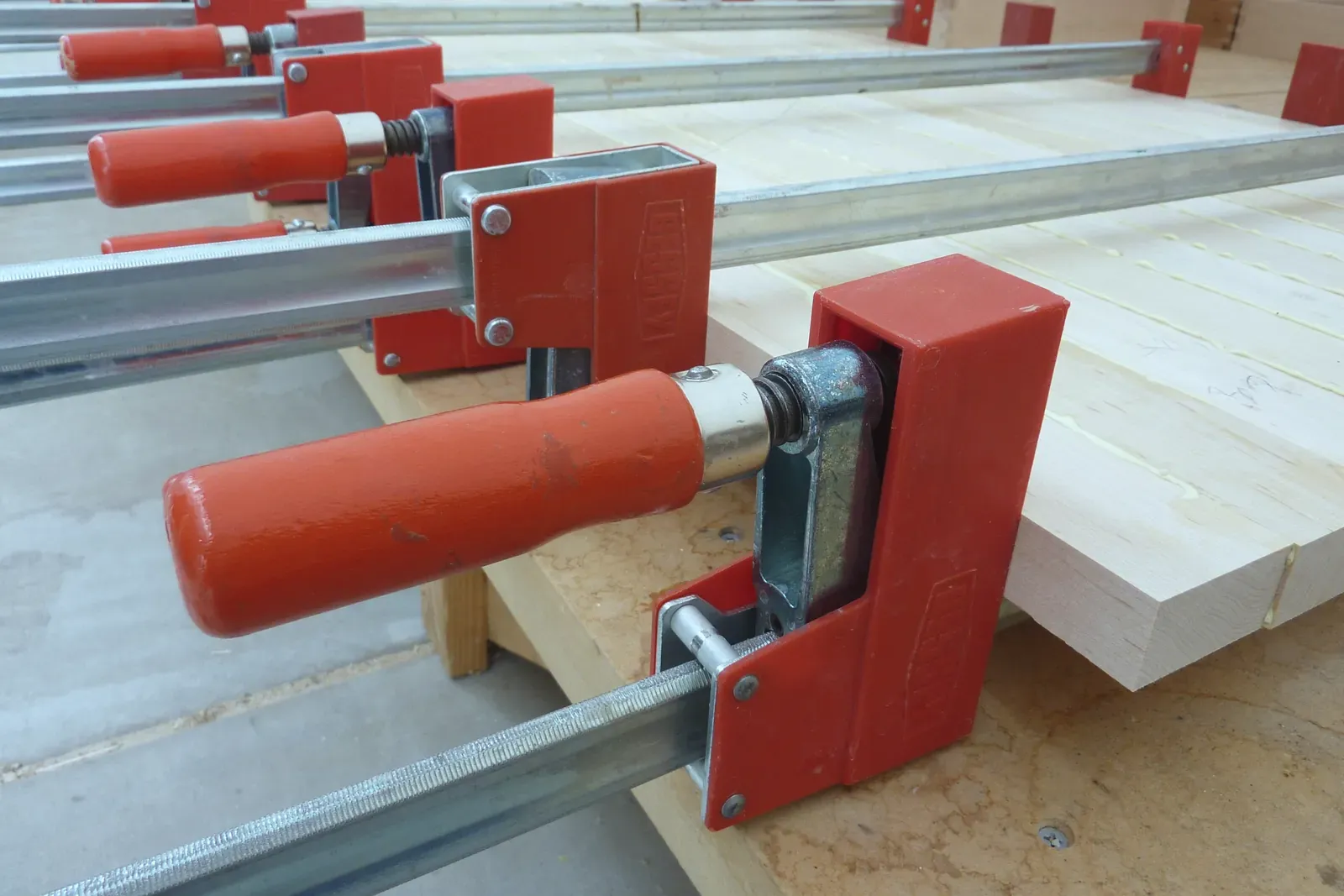
The photo is a maple panel glue-up from Wikimedia Commons. It is not a panel of mine.
Where this comes from
- Titebond (Franklin International). Titebond Original wood glue, spec sheet. Manufacturer spec sheet. Titebond (Franklin International) Consulted 1 Nov 2026. back
- Titebond (Franklin International). Wood glue FAQs. Manufacturer FAQ. Titebond (Franklin International) Consulted 1 Nov 2026. back
- Compañía Casco Argentina. Cola vinílica para madera Casco 1002 (Spanish). Manufacturer spec sheet. Compañía Casco Argentina Consulted 1 Nov 2026. back
- Petrilac. Cola vinílica, uso profesional (Spanish). Manufacturer spec sheet. Petrilac Consulted 1 Nov 2026. back
- Christian Becksvoort, Fine Woodworking. Use wide boards best-side up. Magazine Q&A (membership). Christian Becksvoort, Fine Woodworking Consulted 1 Nov 2026. back
- Ken Burton, Woodcraft Magazine. Expert answers: panel construction, rings up or rings down?. Magazine Q&A. Ken Burton, Woodcraft Magazine Consulted 1 Nov 2026. back
- Rob Johnstone, Michael Dresdner and Ian Kirby, Woodworker's Journal. Ways to prevent panel cupping?. Magazine Q&A. Rob Johnstone, Michael Dresdner and Ian Kirby, Woodworker's Journal Consulted 1 Nov 2026. back
- Christopher Schwarz, Robert W. Lang and Glen D. Huey, Popular Woodworking. Three ways to make edge joints. Magazine article. Christopher Schwarz, Robert W. Lang and Glen D. Huey, Popular Woodworking Consulted 1 Nov 2026. back
- Christopher Schwarz, Popular Woodworking. How & why of spring joints. Magazine article. Christopher Schwarz, Popular Woodworking Consulted 1 Nov 2026. back
- Christopher Schwarz, Popular Woodworking. In defense of splines, grooves, biscuits & Dominos. Magazine blog. Christopher Schwarz, Popular Woodworking Consulted 1 Nov 2026. back
- Fine Woodworking editors, with Hendrik Varju. Clamping cauls: the secret to great glue-ups. Magazine article (membership). Fine Woodworking editors, with Hendrik Varju Consulted 1 Nov 2026. back
- Fine Woodworking editors, from an article by Roman Rabiej. How to glue-up joints: positioning the clamps. Magazine article (membership). Fine Woodworking editors, from an article by Roman Rabiej Consulted 1 Nov 2026. back
- Fine Woodworking editors. How to glue-up joints: different woods need different clamping pressure. Magazine article (membership). Fine Woodworking editors Consulted 1 Nov 2026. back
- woodgears.ca. Can you squeeze all the glue out of a joint?. Independent shop test. woodgears.ca Consulted 1 Nov 2026. back
- Rebecca Wright and Ken Collier, Family Handyman. 9 expert-approved tips for edge-gluing boards perfectly. Magazine article. Rebecca Wright and Ken Collier, Family Handyman Consulted 1 Nov 2026. back
- Tom Caspar, WoodWorkers Guild of America. 6 tips for cleaning up glue squeeze-out. Article. Tom Caspar, WoodWorkers Guild of America Consulted 1 Nov 2026. back
- Foromadera. Presion encolado tablas largas (Spanish). Forum thread. Foromadera Consulted 1 Nov 2026. back
- Foromadera. Unir tablas madera solo con cola (Spanish). Forum thread. Foromadera Consulted 1 Nov 2026. back
Changes in this guide
- First version.
Common questions
How long should wood glue stay clamped?
Whatever your bottle says, because the sheets disagree. Titebond asks for 30 minutes to an hour for an unstressed joint. Casco, an Argentine PVA, asks for 60 to 180 minutes depending on temperature, then 6 hours of rest. Petrilac says about 2 1/2 hours.
Should I alternate the growth rings?
The sources disagree. Woodworker's Journal says yes. Becksvoort and Schwarz say there's no need and arrange by the visible grain. Ken Burton alternates only when the top will have nothing holding it flat.
Do I need biscuits or dowels?
Not for strength, according to Popular Woodworking: a good glue joint is stronger than the wood. Schwarz uses them on tops longer than about 6 ft to keep the boards flush while he clamps.
Have you glued up a panel?
No. This is what I read before gluing up my first one.