How to cut straight with a circular saw or handsaw, and why your cuts aren't square
Circular saw guides, handsaw stance and how to check for square, from the Bosch and Makita manuals, Fine Homebuilding, Family Handyman and Popular Woodworking. I have not tried these methods.
Researched in November 2026. Reviewed . Next review: May 2027. 18 sources
Also in español
How I built this guide
Sources I read. The Bosch GKS 190 and Makita SP6000 manuals; Tom O'Brien in Fine Homebuilding; four Family Handyman pieces; Kreg; This Old House with Norm Abram; Joe Hurst-Wajszczuk at Woodcraft; Christopher Schwarz and American Woodworker in Popular Woodworking; a reader tip in Fine Woodworking; Woodworker's Journal; two Foromadera threads.
What I cross-checked. How far each source wants the blade below the work. The manuals ask for the least; the magazines a bit more.
What I could not verify. No source gives a number for how much to leave on the waste side. Tooth counts are magazine recommendations, not tests. No prices.
A cut that wanders is one of the complaints I found most often searching woodworking forums. Sometimes it’s the hand and sometimes the tool. I have not tried these methods or calibrated a saw. This is what I read, split into circular saw, handsaw, and how to tell whether the saw is what’s crooked.
The short answer
High confidence on circular saw safety: the two manuals agree almost word for word. Medium on the rest, which comes from magazines that don't always say the same thing.
- With a circular saw, use a guide. Bosch says to always use a rip fence or straight edge guide when ripping, because it improves accuracy and reduces the chance of binding.1 Fine Homebuilding only cuts freehand what will be covered up.2
- Don’t trust the factory edge. Family Handyman says straight factory edges are far from universal.3
- Keep the blade just below the work. Bosch and Makita want less than a full tooth showing.45
- With a handsaw, arm and saw in line, no pushing down. Schwarz says excess downward pressure almost always drives you off the line.6
- Before blaming your hand, check for square: the blade, the miter saw and the square itself.789
Part lengths, before you cut, are what the cut list calculator sorts out.
Circular saw
The guide. Bosch suggests fastening a board or rail to the workpiece as an auxiliary guide for straight cuts.10 Tom O’Brien, in Fine Homebuilding, builds one from 3/4 in. plywood about 1 ft. wide: he rips a 2 to 3 in. strip that includes the factory edge and screws it onto the base. The base width equals the distance from the edge of the saw’s baseplate to the blade, so the guide’s edge lands right on the line.11
Guides that ride the panel’s edge have a catch. Woodcraft warns that Kreg’s Rip-Cut follows the edge: if the edge isn’t straight, neither is the cut.12
Depth. Bosch and Makita say less than a full tooth should be visible below the work.1314 Makita adds that the right depth reduces kickback.15
Support. Bosch and Makita say to support large panels on both sides, near the cut line and near the edge, because they sag under their own weight and pinch the blade.1617 Makita says the saw should rest on the larger piece.18 Family Handyman says never to cut between supported ends, like the middle of two sawhorses, because the cut falls into the blade.19 Kreg supports the whole panel on a sheet of 2 in. rigid foam.20 Bosch is plain about the basics: never hold the work in your hands or across your leg.21
If you drift off the line. Makita and Fine Homebuilding agree: don’t twist the saw back. Release the trigger, wait for the blade to stop, back up to where the cut was true and restart with the blade centered in the kerf.2223 Bosch adds never to pull the saw out or backward while the blade is moving.24
The blade. Bosch says dull or badly set blades cut a narrow kerf, which causes friction, binding and kickback.25 Family Handyman lists the signs: rounded or chipped teeth, burn marks, and having to muscle the cut.26
Tearout. Kreg and Fine Homebuilding cut with the good face down, and score the line with a utility knife first.2728
Handsaw
Christopher Schwarz has ten rules. The ones other sources repeat:
- Relaxed grip, index finger extended along the handle. Clenching pushes you off the line.29 Norm Abram also points his index finger.30
- Arm and saw in one straight line. If you feel your elbow touching your torso, you’re doing it wrong.31 For a right-hander, left foot forward and right foot back.32
- Don’t let the blade hide the line. If you can’t see it, you can’t follow it.33
- Almost no downward pressure, using 80 to 90 percent of the teeth on each stroke.34 Norm lets the teeth do the work, with a little pressure on the push and none on the pull.35
- Follow two lines at once, on the face and the edge.36
- Hold the work firmly. Norm says if the wood jiggles, the line comes out wavy.37
The reflection. If the blade is shiny, the board’s reflection in it should line up with the real board. Schwarz uses it to check he’s square,38 and Eric Richter, in Fine Woodworking, to cut square without a line.39 Norm notes it doesn’t work on rusty or coated blades.40
Which saw to start with is in how to choose a first hand saw, and how to lay out the line in measuring and marking.
Why it isn’t square
The circular saw blade. Family Handyman says that if the blade isn’t at 90° to the shoe, any bevel you set will be off. You check it with a square and adjust a set screw, with the saw unplugged or the battery out.41 This Old House warns not to rest the square on a tooth, which gives a false reading, and that a quarter turn of the screw makes a big difference.42
The miter saw. Popular Woodworking cuts a board with straight, parallel edges in half, flips one half over and butts it against the other along the fence. The gap is twice the saw’s error.43 For a table saw sled, the five-cut method multiplies the error by four.44
The square. Draw a line off a straight edge, flip the square and draw another. Andy Rae, in Woodworker’s Journal, says the difference between them is twice the square’s error.45
What users say
On Foromadera, a Spanish-language forum, someone has a circular saw that cuts at an angle, on a rail and off it. Members suggest checking for a warped base, play in the arbor, loose bevel screws and the blade: for another member a worn blade pulled to one side, and changing it fixed things. One member doesn’t trust a square because the blade is thicker at the teeth; they cut the thickest piece they have and adjust the 90° stop, which they say is normal to have to touch. The saw went back to the store, and the thread doesn’t say how it ended.46
In another thread, about Japanese saws that wander, the advice is an extended index finger, moving only the shoulder, a 35 to 40° angle and very light pressure.47
Where they disagree
How far the blade goes below. Bosch and Makita: less than a tooth.4849 Kreg: material thickness plus about 1/8 in.50 Family Handyman: about 1/4 in.51 Fine Homebuilding: no more than 1/4 in.52 The manufacturers’ rule is the shallowest.
How to support. Family Handyman lets the cutoff drop free and clamps one side only.53 The manuals want support on both sides near the cut for large panels.5455 On the forum, one member clamps both pieces and another says a sound saw doesn’t push the offcut.56
Which side of the line. Kreg, Family Handyman and Norm cut on the waste side.575859 Schwarz, with a handsaw, says to work right against the line and avoid sawing a set distance away from it.60 With a knife line, he says he usually splits it.61 Nobody gives a number for how much to leave.
Freehand or guided. Bosch wants a guide for rips.62 Family Handyman says that without a guide, watching the blade on the line is enough.63 Fine Homebuilding cuts sheathing freehand and finish panels with a guide.64
My take
For a first piece of furniture, the circular saw gets a homemade guide like Fine Homebuilding’s, good face down, at whatever depth my saw’s manual asks for. Before cutting anything that matters, I check the square by flipping it, and the blade with the saw unplugged. With the handsaw, I practice on scraps before touching good wood. Schwarz says it takes a couple of days to learn to follow a line.65
Angles for a frame or a many-sided box come from the miter angle calculator.
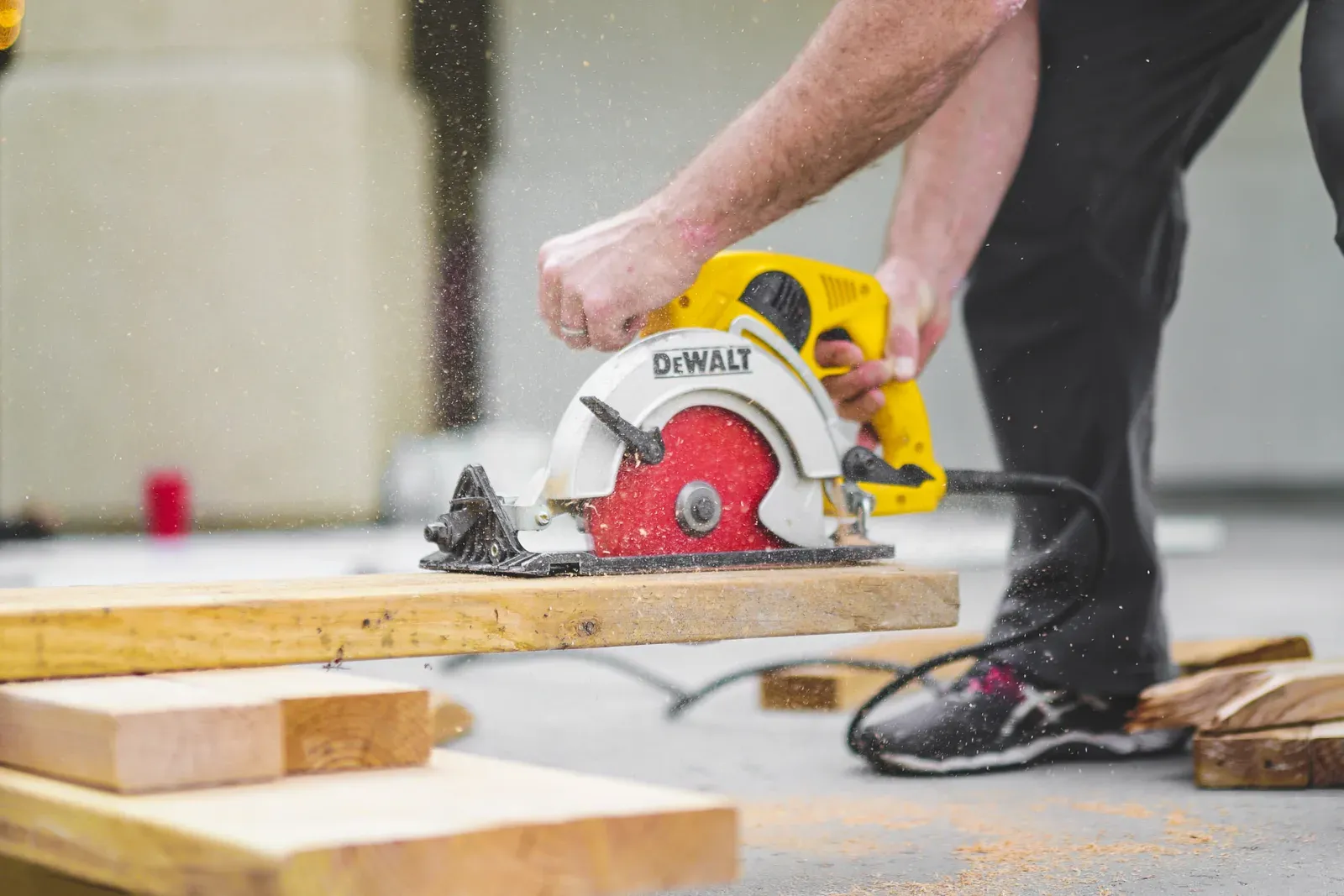
The photo is a circular saw cut from Wikimedia Commons. It isn’t my shop and doesn’t show a guide.
Where this comes from
- Robert Bosch Power Tools. GKS 190 Professional, original instructions. Manufacturer manual (PDF). Robert Bosch Power Tools Consulted 1 Nov 2026. back
- Makita. Sierra de incisión SP6000, manual de instrucciones (Spanish). Manufacturer manual (PDF). Makita Consulted 1 Nov 2026. back
- Tom O'Brien, Fine Homebuilding. Cutting plywood to size. Magazine article (PDF). Tom O'Brien, Fine Homebuilding Consulted 1 Nov 2026. back
- Mike Berner, Family Handyman. How to use a circular saw: a complete guide. Magazine article. Mike Berner, Family Handyman Consulted 1 Nov 2026. back
- Alex Shoemaker, Family Handyman. 11 tips and tricks for cutting straight lines. Magazine article. Alex Shoemaker, Family Handyman Consulted 1 Nov 2026. back
- Family Handyman. 6 tips for making perfect cuts with circular and miter saws. Magazine article. Family Handyman Consulted 1 Nov 2026. back
- Kreg Tool. Beginner's guide to getting straight cuts with a circular saw. Manufacturer guide. Kreg Tool Consulted 1 Nov 2026. back
- This Old House. Circular saw 101: how to square the saw blade. Article. This Old House Consulted 1 Nov 2026. back
- Joe Hurst-Wajszczuk, Woodcraft. Panel-cutting guides. Retailer review. Joe Hurst-Wajszczuk, Woodcraft Consulted 1 Nov 2026. back
- Christopher Schwarz, Popular Woodworking. How to saw (in Handsaw basics). Magazine article (PDF). Christopher Schwarz, Popular Woodworking Consulted 1 Nov 2026. back
- Christopher Schwarz, Popular Woodworking. Splitting the line. Magazine blog. Christopher Schwarz, Popular Woodworking Consulted 1 Nov 2026. back
- Norm Abram, This Old House. Norm's notebook: how to use a handsaw. Article. Norm Abram, This Old House Consulted 1 Nov 2026. back
- Eric Richter, Fine Woodworking. Use saw reflection to cut square. Reader tip (membership). Eric Richter, Fine Woodworking Consulted 1 Nov 2026. back
- American Woodworker, Popular Woodworking. Is your miter saw square?. Magazine blog. American Woodworker, Popular Woodworking Consulted 1 Nov 2026. back
- American Woodworker, Popular Woodworking. Testing for square. Magazine tip. American Woodworker, Popular Woodworking Consulted 1 Nov 2026. back
- Andy Rae, Carol Reed and Richard Jones, Woodworker's Journal. How can you tell if your square is square?. Magazine Q&A. Andy Rae, Carol Reed and Richard Jones, Woodworker's Journal Consulted 1 Nov 2026. back
- Foromadera. Sierra circular corta inclinado (Spanish). Forum thread. Foromadera Consulted 1 Nov 2026. back
- Foromadera. Manejo de las sierras japonesas (Spanish). Forum thread. Foromadera Consulted 1 Nov 2026. back
Changes in this guide
- First version.
Common questions
Why won't my circular saw cut straight?
The sources name several causes: cutting freehand, following a factory edge that isn't straight, a dull blade, or a blade that isn't at 90° to the base. Family Handyman and This Old House explain how to check the blade for square with the saw unplugged.
How far should the blade go below the wood?
The Bosch and Makita manuals say less than a full tooth should show below the work. The magazines give 1/8 to 1/4 in. Your saw's manual is the one that counts.
Which side of the line do I cut on?
The waste side, according to Kreg, Family Handyman and Norm Abram. Christopher Schwarz, with a handsaw, prefers to saw right on the line, or split it.
Have you tried these methods?
No. This is what I read before cutting for real.