Measuring and marking, before you cut
A knife line that a saw can feel, from Popular Woodworking. I have not marked out a joint.
Researched in October 2026. Reviewed . Next review: April 2027. 4 sources
Also in español
Research guide: I have not tested these products. Affiliate disclosure As an Amazon Associate I earn from qualifying purchases.
How I built this guide
Sources I read. Popular Woodworking’s “Better Than a Pencil,” the striking-knife article, and Christopher Schwarz’s “The Black Knife.”
What I cross-checked. That a knife line is a physical track, and that open-grained oak can hide it.
What I could not verify. Which combination square is square. No brand test in these articles.
Most sources suggest this if you will saw to a line and the line has to survive until then; skip it if you only need a rough length on construction lumber.
As an Amazon Associate I earn from qualifying purchases.
Combination square
Budget to mid. One source, no second opinion.
Popular Woodworking’s knife article assumes a square you can trust, then transfers the line with the knife in the nick. I have not checked a square against a known edge.
A cheap square can be out. This note does not name a brand I verified.
Opens Amazon. Price and stock change. I have not used this. Affiliate link: if you buy, I may earn a commission. You do not pay more.
Marking knife
Budget. More than one source agrees.
Popular Woodworking’s “Better Than a Pencil”: a knife line stays, a pencil line smears, and the saw can start in the knife track.
On open-grained oak, Schwarz writes that a knife line can hide, so he darkens it with a 0.3 mm pencil.
Opens Amazon. Price and stock change. I have not used this. Affiliate link: if you buy, I may earn a commission. You do not pay more.
The cut can only be as honest as the line. I have not marked a joint. The saw that is supposed to follow the line is here.
What the articles actually show
Medium. Three Popular Woodworking pieces agree that a knife line is a physical place. They are not a test of squares.
“Better Than a Pencil” says pencil lines rub off and knife lines do not. The method there is to hold the knife so the flat of the bevel is against the square, nick the far corner, and draw the knife toward you. The second use is registration: put the knife back in the nick and bring the square to the knife, so the line on the next face starts from the same point instead of from your eye. The third is the saw: lay the teeth in the knife mark and the cut starts on the line, if you do not lean the saw.1
The striking-knife article says the same transfer in more detail. Cross-grain, the knife is nearly vertical, a deep nick at the far corner, a light draw toward you, a nick at the near corner. Those nicks are how you re-seat the square on the edge. It also says not to force the knife: a heavy cut wanders.2
Schwarz, on oak and other coarse wood, says a knife line can disappear into the grain. His fix is a 0.3 mm mechanical pencil down in the groove. A 0.5 mm or 0.7 mm lead, he writes, rides the two lips of the cut and hops into a grain line.3
Where I will not pretend
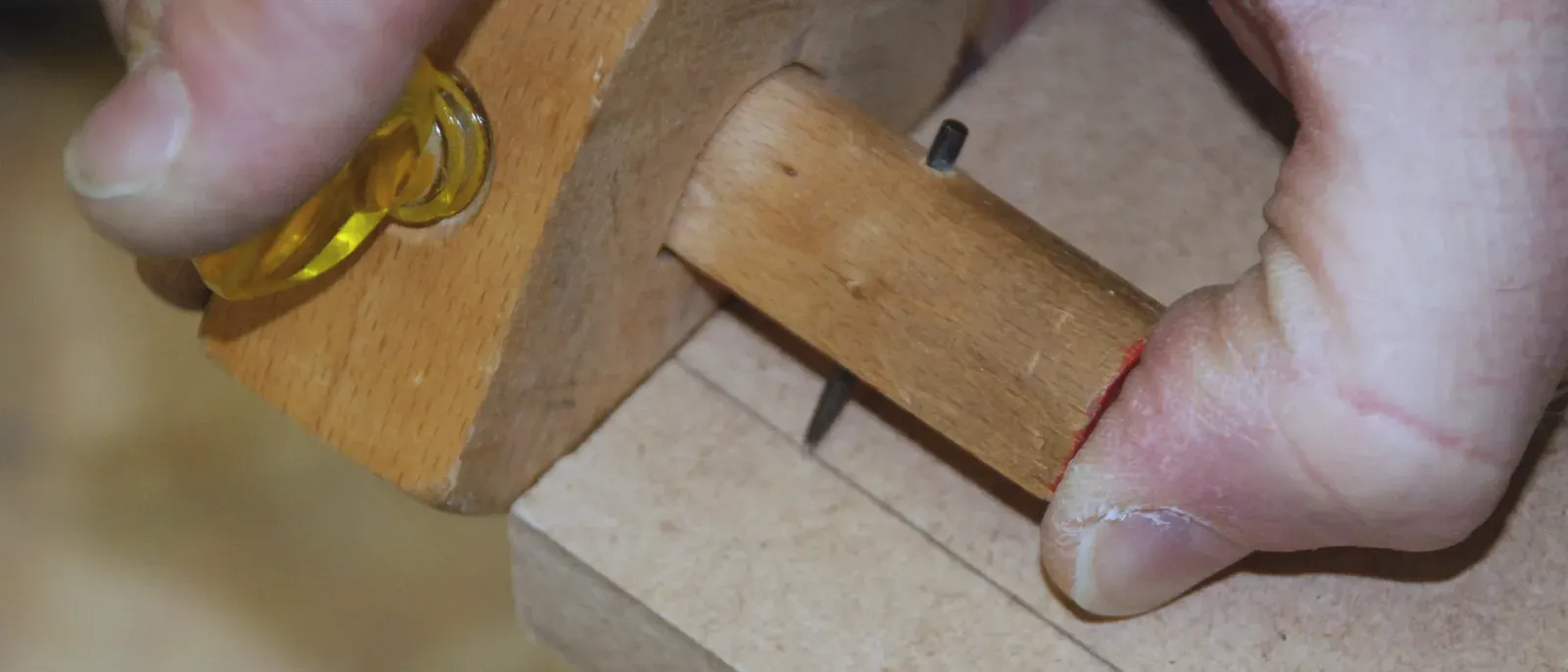
None of these pages tells you a brand of square is in tolerance. A square that is out copies the error onto every face, and the knife trick only transfers whatever the square gave you. I have not checked one against a known edge. The gauge in the photo is scribing parallel to an edge. That is a different job from squaring an end, and the photo does not name a model.
My take
For a joint you will saw, the published habit is a knife line, transferred from a nick, with a fine pencil only to make the groove visible on open grain. Construction lumber that you will hide can stay a pencil. I have not done either. The bench you mark on is here. The chisel that pares to the line is here.
The gauge itself, pin, wheel or cutting, has its own note: how to choose a marking gauge.
Where this comes from
- Popular Woodworking. Better Than a Pencil. Technique article. Popular Woodworking Consulted 29 Oct 2026. back
- Popular Woodworking. The Striking Knife. Technique article. Popular Woodworking Consulted 29 Oct 2026. back
- Christopher Schwarz, Popular Woodworking. The Black Knife. Technique article. Christopher Schwarz, Popular Woodworking Consulted 29 Oct 2026. back
- Veta. How to choose a first hand saw. This notebook. Veta 29 Oct 2026. back
Changes in this guide
- First note. The saw that follows the line is a different page.
Common questions
Pencil or knife?
Popular Woodworking’s case for the knife is that the line does not smear and the saw teeth can start in the groove. Schwarz adds that on coarse oak the groove can look like grain, so he darkens it with a 0.3 mm pencil that sits in the cut.
Have you checked a square?
No. These articles assume the square is true. I have not proved one.