How to choose a marking gauge: pin, wheel or cutting gauge
One Fine Woodworking test and four other write-ups on a first gauge. I have not scribed a line with any of them.
Researched in October 2026. Reviewed . Next review: April 2027. 6 sources
Also in español
Research guide: I have not tested these products. Affiliate disclosure As an Amazon Associate I earn from qualifying purchases.
How I built this guide
Sources I read. Jeff Miller’s Fine Woodworking gauge test, Steve Latta on pin and slicing gauges, two Scott Gibson roundups, Wood and Shop’s layout tool guide, and an American Woodworker Q&A on tuning a cutting gauge.
What I cross-checked. That the pin-tears-across-the-grain rule appears in more than one source, and where Miller and Wood and Shop say opposite things about the same Veritas gauge.
What I could not verify. Paul Sellers’ advice to buy a mortise or combination gauge first, seen only as a search summary. Any price, and any spec not printed in these articles.
Most sources suggest this if will mark tenon shoulders and want one gauge that cuts cleanly both with and across the grain; skip it if only need a width line on construction lumber, or want a graduated beam to do the measuring for you.
As an Amazon Associate I earn from qualifying purchases.
Veritas Wheel Marking Gauge (standard)
Budget. The sources disagree. Read the notes in the guide.
Best Value in Jeff Miller’s Fine Woodworking test. He called a wheel gauge the easiest type to use, and said its O-ring holds the setting while the fence still slides.
Miller says it may roll off the bench. Wood and Shop says the shaft slipped with its single thumbscrew.
Opens Amazon. Price and stock change. I have not used this. Affiliate link: if you buy, I may earn a commission. You do not pay more.
Tite-Mark marking gauge
Premium. One source, no second opinion.
Miller’s favorite overall gauge, for its micro-adjuster, one-handed setting and sharp cutters you can see. Gibson’s older roundup also lists it as a micro-adjust wheel gauge.
Miller says the longest model may roll off the bench. Wood and Shop treats it as the higher-end option.
Opens Amazon. Price and stock change. I have not used this. Affiliate link: if you buy, I may earn a commission. You do not pay more.
iGaging Wheel Marking Gauge
Budget. One source, no second opinion.
Miller’s pick if price is the main concern. It has an O-ring like the Veritas, though less smooth.
Miller says the disk would benefit from some honing. Wood and Shop warns that many very cheap wheel gauges are poorly made.
Opens Amazon. Price and stock change. I have not used this. Affiliate link: if you buy, I may earn a commission. You do not pay more.
Crown rosewood and brass cutting gauge
Mid. One source, no second opinion.
Miller says it tightens securely and cuts well. Steve Latta names Crown among traditional Western slicing gauges with the wide wood fence he prefers.
Miller found fit and finish made fence adjustments fussy, and the knife shipped bevel out.
Opens Amazon. Price and stock change. I have not used this. Affiliate link: if you buy, I may earn a commission. You do not pay more.
Basic wooden pin marking gauge
Budget. More than one source agrees.
Gibson says pin gauges are best with the grain, and Miller suggests one as a second gauge for lines along the board. Latta and Gibson both say the pin can be filed into a cutter.
Across the grain the pin tears fibers and leaves a fuzzy line.
Opens Amazon. Price and stock change. I have not used this. Affiliate link: if you buy, I may earn a commission. You do not pay more.
A marking gauge scratches a line parallel to an edge. The cutter leaves a groove that a chisel or a saw can find. I have not scribed a line with one. Knife lines and squares are in the marking note.
Which marking gauge should a beginner buy?
If you can only have one, the sources point to a gauge that cuts, a wheel or a knife, not a pin. Jeff Miller, testing for Fine Woodworking, says a pin works well along a board but tends to tear across it. For one tool that does it all, he says, pick a knife or disk type.1
- Pin gauge: best with the grain. Across the grain it tends to tear fibers and leave a fuzzy line.2
- Cutting (knife) gauge: a small blade in place of the pin, for clean lines across the grain. The blade has to stay very sharp.3
- Wheel gauge: a sharpened disc at the end of the beam. It makes crisp lines with or across the grain.4
- Mortise gauge: two cutters, for both sides of a mortise.5 It can wait. Wood and Shop says a marking gauge alone gets you by on a tight budget.6
What the experts say
Medium. One hands-on test and four write-ups agree on the grain rule. They do not agree on whether one popular wheel gauge holds its setting.
Steve Latta explains why the pin struggles. It cuts a V that rips the fibers across the grain, for example on a tenon shoulder. A slicing gauge has a cutter that is flat outside and beveled inside. That wedge pulls the fence tight to the edge and keeps the blade from wandering. The bevel sits on the waste side.7 He also says you can file a pin into a cutter: outside face flat, inside face angled.8 Scott Gibson gives the same workaround.9
Miller tested only cutting gauges, knives and disks, scoring lines with and across the grain in several woods.10 Both cutter types worked. Knives cut a little deeper. Disks sit at the end of the beam, so you can see where a line starts and stops. His favorite overall was the Tite-Mark, for its micro-adjuster. He called a wheel gauge the easiest type to use and named the standard Veritas wheel gauge the value pick.11
Latta is cooler on wheels. The wheel does not spin; you turn a fresh section when it dulls. But the small round fence gives little support, and he finds the type awkward. He prefers a wide wood fence.12
What to check when buying
What the sources actually name:
- The lock. Miller dropped gauges whose fence pivoted or shifted no matter how hard he tightened the thumbscrew. A dull cutter can be fixed. A shifty fence cannot.13 On a used gauge, Wood and Shop says to check that it slides smoothly and stays put when tightened.14
- Adjustment. Miller preferred a micro-adjuster on the fence, and one-handed setting so the other hand holds the ruler.15
- The beam. He would not pay extra for a graduated beam. Setting from a good ruler was just as accurate, and on one gauge the etched scale was 1/32 in. off. Some round beams roll off the bench. An off-center shaft resists that.16
- The fence face. A bigger bearing surface is easier to hold against the edge. That is Latta’s case for a wide wood fence.17 Brass wear strips are nice, not essential. Gibson’s Marples, more than 25 years old, has none and shows almost no wear.18
- The cutter. Ease of sharpening is on Gibson’s short list.19 A cutting gauge that leaves a ragged line may just need its knife reshaped: round the tip and give it one bevel facing the head.20
What owners report
Joshua Farnsworth at Wood and Shop says the shaft of his Veritas wheel gauge kept slipping unless he was careful. He blames the single thumbscrew, and prefers a wheel gauge with an adjustable barrel and two thumbscrews. He also says many of the very cheap wheel gauges he tried were poorly made.21 Wood and Shop has affiliate links and sells things, so I read it as a craftsman’s notes, not a lab.
Where they disagree
The standard Veritas wheel gauge is Miller’s value pick. He says its O-ring holds the setting and still lets the fence slide.22 Farnsworth says the same brand slipped on him.23 I do not know if they had the same version. I cannot settle it without one in my hand.
On wheel gauges in general, Miller calls them the easiest to use and Latta finds the small fence awkward. Same tool type, two opposite sentences.
On the mortise gauge, a search summary credited Paul Sellers with the view that a twin-pin mortise gauge, or a combination gauge, is the one to buy first. His pages returned an error when I tried to open them. So it is not a source here.
My take
If I bought one gauge tomorrow, it would be a wheel or knife gauge. Tenon shoulders run across the grain, and that is where a pin tears.24 I would test the lock first: tighten it and push the fence. I would not pay for a scale on the beam. A pin gauge can come later. The mortise gauge waits for the first mortise.
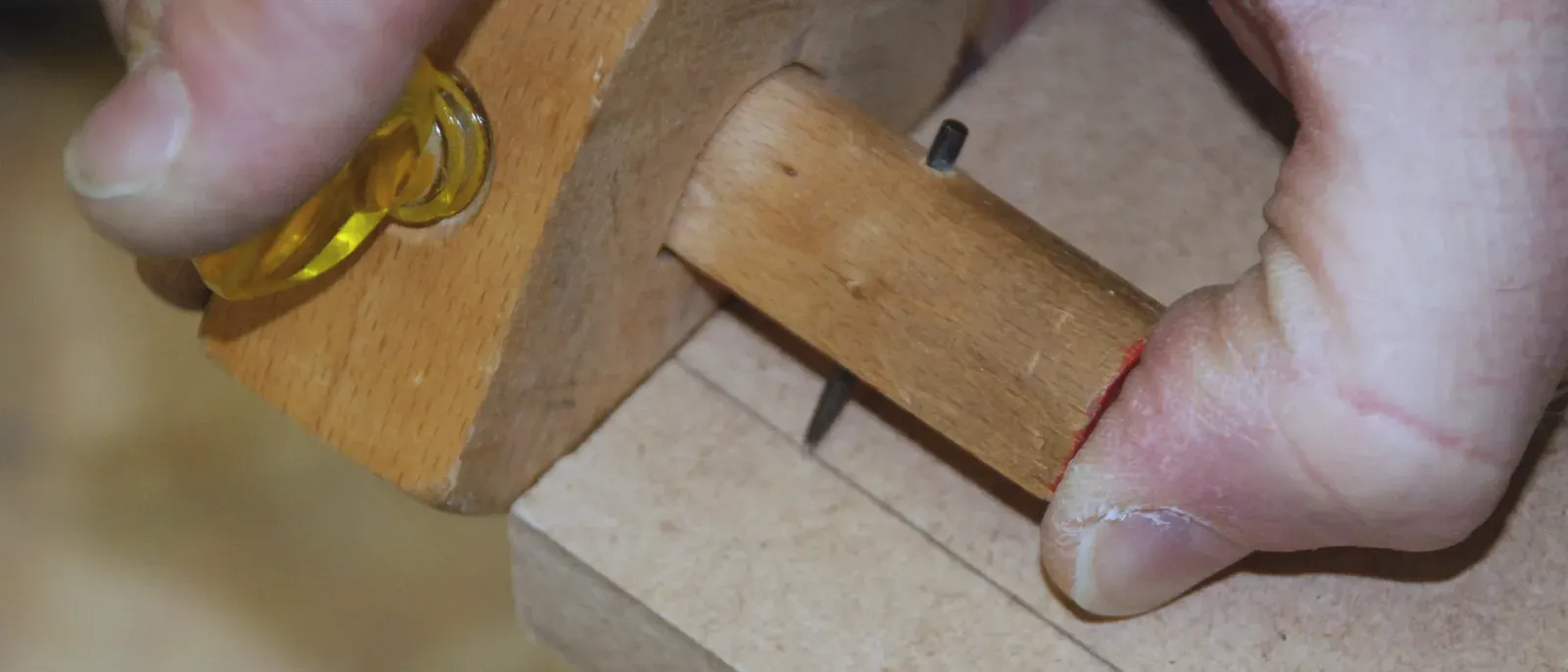
The chisel that pares to the gauge line is in the chisel note. The photo is a gauge on MDF. I do not know the model.
Where this comes from
- Jeff Miller, Fine Woodworking. Tool Test: Marking Gauges. Comparative test. Jeff Miller, Fine Woodworking Consulted 31 Oct 2026. back
- Steve Latta, Fine Woodworking. Pin Gauges vs. Slicing Gauges. Technique article. Steve Latta, Fine Woodworking Consulted 31 Oct 2026. back
- Scott Gibson, Fine Woodworking. All About Marking Tools. Buying guide. Scott Gibson, Fine Woodworking Consulted 31 Oct 2026. back
- Scott Gibson, Fine Woodworking. Choosing Marking Tools. Buying guide. Scott Gibson, Fine Woodworking Consulted 31 Oct 2026. back
- Joshua Farnsworth, Wood and Shop. Layout, Marking & Measuring Tools (Hand Tool Woodworking Buying Guide #2). Review. Joshua Farnsworth, Wood and Shop Consulted 31 Oct 2026. back
- American Woodworker editors, Popular Woodworking. Q & A: Cutting Gauge Tune-Up. Q&A. American Woodworker editors, Popular Woodworking Consulted 31 Oct 2026. back
Changes in this guide
- First version.
Common questions
Wheel gauge or pin gauge for a first one?
Miller’s advice in Fine Woodworking is a knife or disk gauge if you want one tool for everything, and a pin gauge only as a second tool for lines along the grain. A pin tends to tear across the grain.
Do I need a mortise gauge now?
Wood and Shop says a marking gauge alone will do on a tight budget, and a mortise gauge mostly saves time and mistakes. A search summary credits Paul Sellers with the opposite advice. I could not open his page, so I left it unverified.
Is the gauge in the photo one to buy?
No. The photo shows a marking gauge scribing a line on MDF. The model is not identified, and it is not a recommendation.