How to choose a first hand saw
Rip, crosscut, and the one-blade pull saw, from maker geometry. I have not sawn a board with any of them.
Researched in October 2026. Reviewed . Next review: April 2027. 3 sources
Also in español
Research guide: I have not tested these products. Affiliate disclosure As an Amazon Associate I earn from qualifying purchases.
How I built this guide
Sources I read. Lee Valley’s Veritas tenon-saw page and their dual-purpose pull saw page.
What I cross-checked. That crosscut teeth are described as severing fibers, and rip teeth as a rake for cutting with the grain.
What I could not verify. Which current Amazon listing matches those Lee Valley models. The buttons are searches.
Most sources suggest this if you want one saw that the maker says will both rip and crosscut; skip it if you already know you are cutting tenons and want a dedicated backsaw.
As an Amazon Associate I earn from qualifying purchases.
Pull saw that rips and crosscuts
Budget. Maker or shop pages, not an independent test.
Lee Valley’s construction pull saw is sold as one 14 tpi blade for both rip and crosscut. I have not confirmed a current Amazon listing.
A shop page, not an independent test.
Opens Amazon. Price and stock change. I have not used this. Affiliate link: if you buy, I may earn a commission. You do not pay more.
Western crosscut panel saw
Mid. One source, no second opinion.
Lee Valley’s Veritas crosscut files alternating bevels so the teeth sever fibers. That is geometry, not a test I ran.
A rip saw is a second tool.
Opens Amazon. Price and stock change. I have not used this. Affiliate link: if you buy, I may earn a commission. You do not pay more.
A first saw is a question about the cut, not about a brand. I have not made the cut. The brand comparison, Japanese against western, is already in this notebook. This note is only the tooth.
What the geometry says
Medium. Two Lee Valley pages, both commercial, describe the teeth. They are not an independent test.
On the Veritas tenon saws, the rip pattern is 9 teeth per inch with a 14° rake, for cutting with the grain. The crosscut is 12 teeth per inch, with a 15° rake and alternating 15° bevels, and Lee Valley says those teeth sever fibers instead of tearing them.1 That is the whole difference I am willing to repeat: crosscut teeth are knives across the grain, rip teeth are more of a chisel along it. I did not file either one.
Their construction pull saw is sold as one 14 tpi blade that both rips and crosscuts, cutting on the pull stroke, including plywood and particleboard.2 One blade, two jobs, is the beginner case. Two dedicated saws are for when you already know which cut you do all day.
Where they disagree
They do not, on this narrow point. A shop that sells both a dual-purpose pull saw and a rip/crosscut pair is not telling you those are the same tool. The pair is for tenons. The pull saw is the one they describe as covering both directions. I have not used either, so I am not ranking them.
My take
If you are buying one saw before you know whether you rip or crosscut more, the published description that matches that job is a pull saw the seller says does both. If you already cut joinery to a line, the filed difference above is why a crosscut backsaw and a rip backsaw are not interchangeable. Mark the line first. The knife note is here.
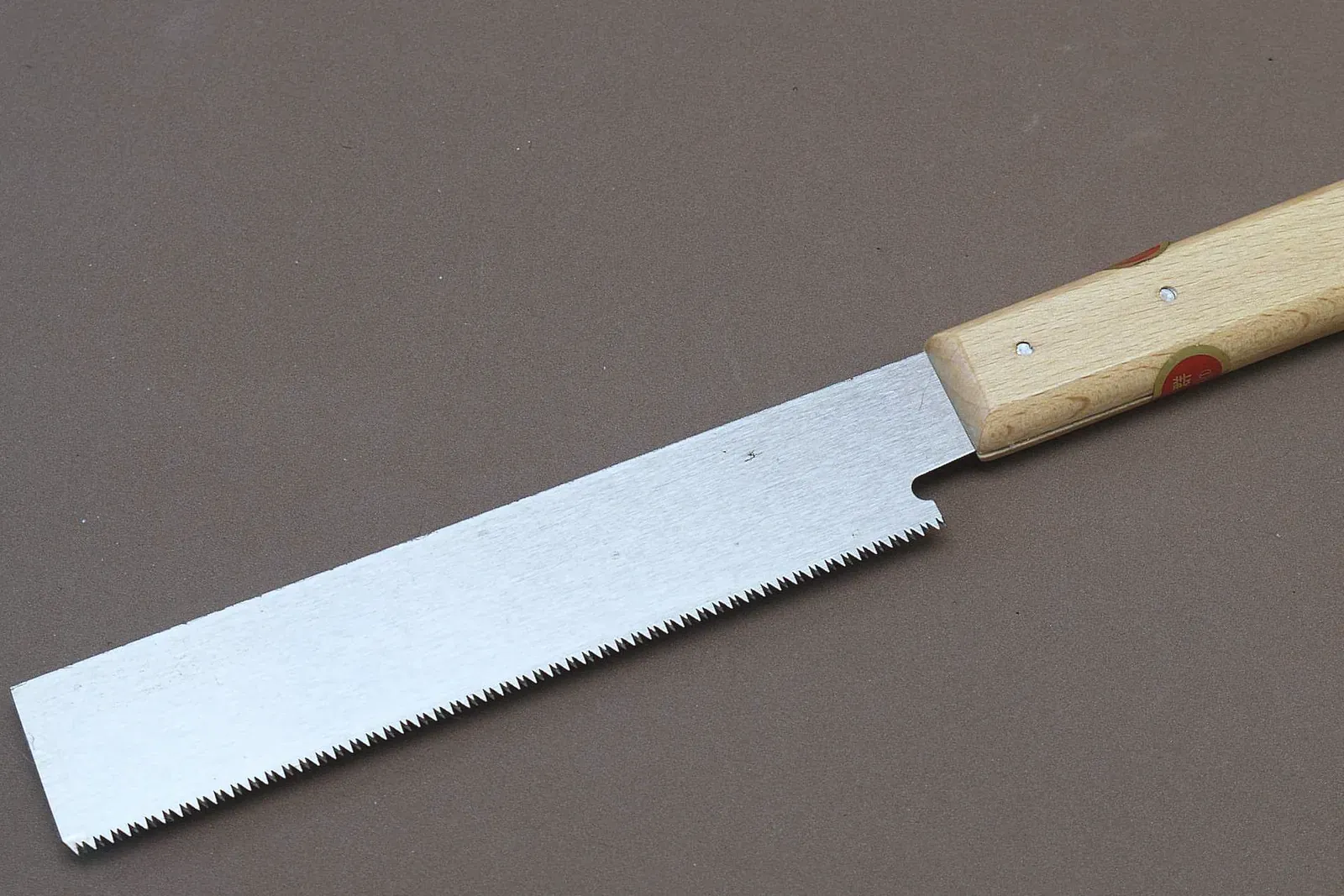
The photo is a kugihiki. Do not shop from it.
Where a saw fits in a whole first kit is in beginner woodworking tools.
Where this comes from
- Lee Valley. Veritas rip and crosscut tenon saws. Maker page. Lee Valley Consulted 29 Oct 2026. back
- Lee Valley. Japanese rip/crosscut saw. Shop page. Lee Valley Consulted 29 Oct 2026. back
- Veta. Japanese saw or western saw. This notebook. Veta 29 Oct 2026. back
Changes in this guide
- First note. Model picks stay in the Japanese-or-western guide.
Common questions
Do I need two saws?
Not on day one. Lee Valley sells a pull saw as one blade for both rip and crosscut. A dedicated rip and a dedicated crosscut are a later pair, and they are filed differently.
Is the photo the saw to buy?
No. It is a kugihiki, a flexible flush-cutting saw. It is not a ryoba and not a western panel saw.