Beginner woodworking tools: what five teachers buy first, round by round
Kate Swann, Wood and Shop, The English Woodworker and two Popular Woodworking editors, side by side. I have not bought this kit.
Researched in October 2026. Reviewed . Next review: April 2027. 5 sources
Also in español
Research guide: I have not tested these products. Affiliate disclosure As an Amazon Associate I earn from qualifying purchases.
How I built this guide
Sources I read. Kate Swann in Fine Woodworking (2025), Joshua Farnsworth at Wood and Shop, Richard Maguire at The English Woodworker (2018), and two 2007 Popular Woodworking pieces by Christopher Schwarz and Robert W. Lang.
What I cross-checked. Which tools sit in each first round, and where a numbered list does not claim to be a buying order.
What I could not verify. Paul Sellers’ lists, Rex Krueger’s twelve tools, and every price. I left prices out on purpose.
Most sources suggest this if want a first round you can name in one breath, and you will sharpen what you buy; skip it if want one teacher’s list with no gaps, or prices this note does not print.
As an Amazon Associate I earn from qualifying purchases.
6-inch combination square
First purchase. More than one source agrees.
On Kate Swann’s first list in Fine Woodworking, on Wood and Shop’s list, and in Maguire’s measuring kit. Swann uses it for joinery layout and tool setup.
Wood and Shop warns a cheap one gets replaced for inaccuracy. Swann says get one you can trust to be square.
Opens Amazon. Price and stock change. I have not used this. Affiliate link: if you buy, I may earn a commission. You do not pay more.
Narex bevel-edge chisel set (4 pieces)
First purchase. The sources disagree. Read the notes in the guide.
Swann names this four-piece set as a good-value starter. Maguire also starts with a small set of three.
The count is not settled: Wood and Shop says 5 to 7, Maguire three. Swann and Wood and Shop both say you need a way to keep them sharp.
Opens Amazon. Price and stock change. I have not used this. Affiliate link: if you buy, I may earn a commission. You do not pay more.
Japanese pull saw (ryoba)
First purchase. More than one source agrees.
Swann says a pull saw starts a cut more easily and binds less. Maguire and Schwarz also point a beginner to a Japanese saw.
Swann adds that a Western backsaw’s stiff back is a little better for precise joinery.
Opens Amazon. Price and stock change. I have not used this. Affiliate link: if you buy, I may earn a commission. You do not pay more.
Wheel marking gauge
First purchase. More than one source agrees.
Swann’s first list has a Veritas wheel gauge and she finds the wheel type easier than a knife gauge. Wood and Shop says you cannot build furniture without a good marking gauge.
No source compares gauge brands. Swann’s pick is one maker’s model.
Opens Amazon. Price and stock change. I have not used this. Affiliate link: if you buy, I may earn a commission. You do not pay more.
No. 5 jack plane
Second round. The sources disagree. Read the notes in the guide.
Maguire’s kit starts with one No. 5 jack with two irons, learned well before any other plane. Wood and Shop also lists a jack plane early.
Swann puts planes in her later round, and her bench plane pick is a low-angle smoother, not a jack.
Opens Amazon. Price and stock change. I have not used this. Affiliate link: if you buy, I may earn a commission. You do not pay more.
I have not bought a starter kit. I have read what five teachers and editors put on their first lists, and the lists do not match. That mismatch is the useful part. Budget here means rounds of buying, not prices.
Beginner woodworking tools: the short answer
Medium. The first round overlaps a lot across these lists. The order after that does not.
If you want one list to start, this is the overlap I found:
- First purchases: a 6-inch combination square, a marking knife, a marking gauge, a tape measure, a few bevel-edge chisels, a mallet, one saw and a way to sharpen.
- Second round: a bench plane, clamps, a coping saw, a card scraper.
- Later: a block plane, a router plane, more saws, a sliding bevel.
Kate Swann runs the Florida School of Woodwork. Her first group is a tape, a 6-inch combination square, a marking knife, a wheel marking gauge, bench chisels, a mallet and one handsaw, and she says to buy them together.1 Planes, a spokeshave, a scraper and a coping saw come after your skills grow. Measuring comes first for me too, in measuring and marking basics.
What the experts say
Joshua Farnsworth at Wood and Shop lists 20 hand tools, starting with a workbench, then a jack plane, a low-angle block plane and panel saws.2 He numbers them but does not say the number is the buying order. He says 5 to 7 bench chisels will get you going and they don’t have to match. He warns that a cheap combination square ends up replaced. The site has a store and affiliate links, so I read it as a shop page.
Richard Maguire, The English Woodworker, starts with one bench plane: a No. 5 jack with two irons. Then three chisels, one up to 6 mm, one in the middle, one around 19 mm.3 Then square, rule, knife, pencil, tape and gauge, a Japanese back saw, a cheap hardpoint panel saw, a mallet, a drill and an oil stone. He says a small kit can be a preference, not only a budget.
Christopher Schwarz, in a 2007 Popular Woodworking piece, starts with chisels, a backsaw and a coping saw.4 If you are not set on vintage, he suggests a new Japanese-style backsaw, because the pull stroke is easier to control.
Robert W. Lang, also at Popular Woodworking, says the hard part is sorting the tools you want from the ones you think you need.5 For saws: get one decent one and learn on it.
What owners report
These are people describing their own kits, not tests. Lang’s list is mostly old or inherited, down to his grandfather’s No. 4 smoother.6 Maguire says he has not touched a block plane in three years.7 Under his post, a reader tells beginners to buy chisels new because used ones are often pitted or bellied. Maguire agrees. Swann says her first group gets used in almost every class at her school.8
Where they disagree
Set or singles. Swann says buy the first group at once. Lang added single pieces as he needed them. For chisels, Wood and Shop says 5 to 7, Maguire says three, Swann names a four-piece Narex set. My chisel notes are in first chisel set.
Used or new. Schwarz likes flea markets for choice and haggling. He warns a used tool rarely comes with a refund and some need restoring.9 Wood and Shop says most hand tools can be vintage, but a used shoulder plane is hard to rehab.10 Swann’s cost estimate is for new tools.
Which plane, and when. Maguire starts with a jack and skips the block plane. Wood and Shop lists a jack and a low-angle block plane near the top. Swann puts both planes in the later round, because harder tools can wait. I wrote about that choice in block plane or bench plane.
Which saw. Swann and Maguire both point a beginner to a Japanese saw. Swann adds that a Western backsaw’s stiff back is a little better for precise joinery. Wood and Shop starts with two Western panel saws. The saw notes are in how to choose a first hand saw.
Power or hand. Schwarz says even a power tool fan will need about 20 hand tools. Maguire would take a small cordless drill. Lang says hand tools make power-tool setups more accurate. None of these lists has a sander in it. Mine waits, with the sander note.
My take
If I were buying this week, I would follow the overlap. First round: a 6-inch combination square I can trust, a knife, a wheel gauge, a tape, three or four bevel-edge chisels, a mallet, one Japanese pull saw and something to sharpen on. That is roughly Swann’s first group, and Maguire’s list without the plane.
Second round: one bench plane, learned well before another, which is Maguire’s advice. Clamps and a coping saw. And a place to work, which Wood and Shop puts first. My bench note is here.
Later: block plane, router plane, more saws. Glue joins the list with the first real joint, in the glue note.
Spend where the sources warn you: the square, for Wood and Shop and Swann, and the chisels, for Wood and Shop. Go cheap where Lang and Maguire say cheap works, like a knife or a hardpoint saw. Then make something. That is Lang’s line, and the one I need most.
Where this comes from
- Kate Swann, Fine Woodworking. Kate Swann’s essential hand-tool kit (2025). Teacher’s kit list. Kate Swann, Fine Woodworking Consulted 31 Oct 2026. back
- Joshua Farnsworth, Wood and Shop. Step 1: Understand & buy the right woodworking hand tools. Buying guide (site with a store and affiliate links). Joshua Farnsworth, Wood and Shop Consulted 31 Oct 2026. back
- Richard Maguire, The English Woodworker. Which hand tools do I need to get started? (2018). Guide. Richard Maguire, The English Woodworker Consulted 31 Oct 2026. back
- Christopher Schwarz, Popular Woodworking. Hand tools for $100 (2007, page 1). Guide. Christopher Schwarz, Popular Woodworking Consulted 31 Oct 2026. back
- Robert W. Lang, Popular Woodworking. Confusing the beginners: another tool list (2007). Editor’s blog post. Robert W. Lang, Popular Woodworking Consulted 31 Oct 2026. back
Changes in this guide
- First version.
Common questions
What should a beginner buy first?
The overlap I found: a 6-inch combination square, a marking knife, a marking gauge, a tape, a few bevel-edge chisels, a mallet, one saw and a way to sharpen. That is close to Kate Swann’s first group. It is a reading of five lists, not a kit I have used.
New or used?
The sources split. Schwarz likes flea markets and warns there is rarely a refund. Wood and Shop says most hand tools can be vintage, except a shoulder plane. Under Maguire’s post, a reader says buy chisels new, and Maguire agrees.
Is the bench in the photo a kit to buy?
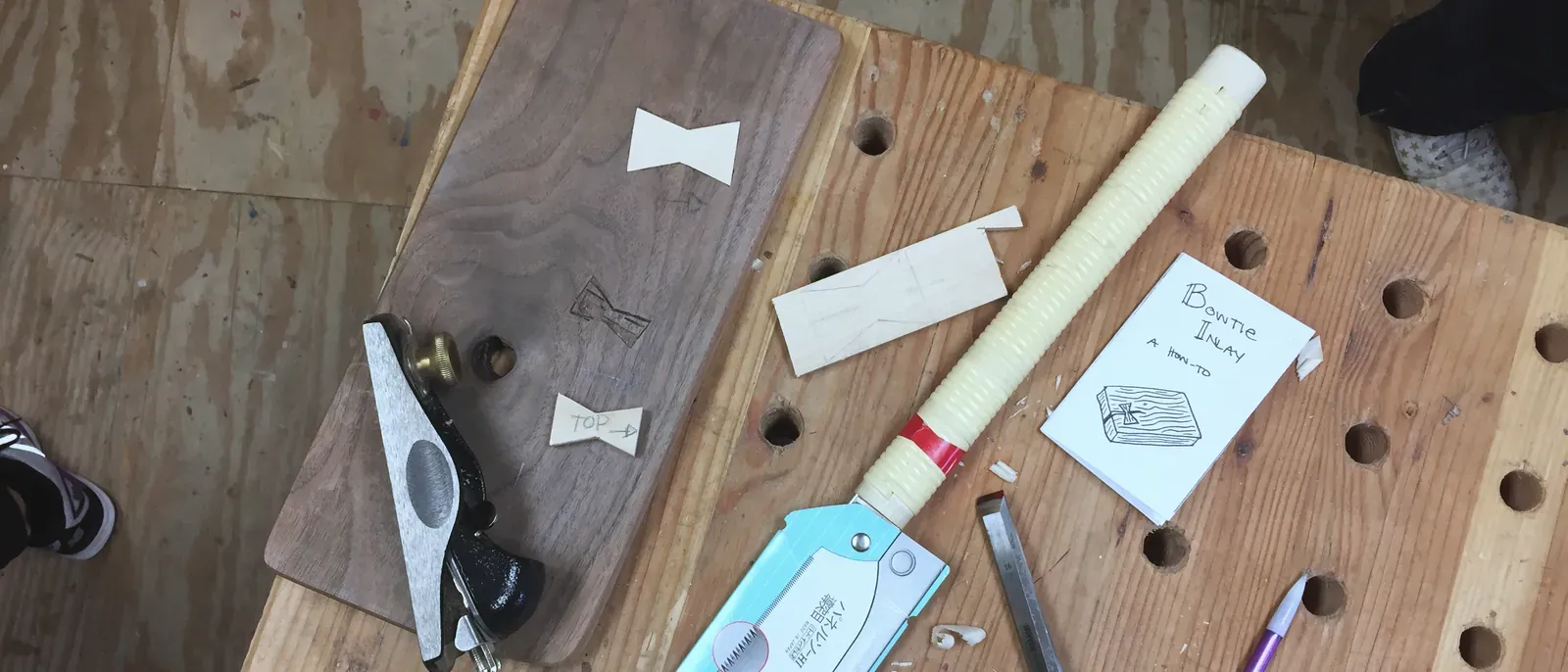
No. It is a bench at the Women’s Woodshop in Minneapolis with a block plane, a Japanese saw still in its package and a chisel. It is not my kit and not a brand recommendation.