How to sharpen a chisel, from two published methods
A 30° bevel from Lie-Nielsen, and Paul Sellers’ freehand camber. I have not honed a chisel.
Researched in October 2026. Reviewed . Next review: April 2027. 5 sources
Also in español
Research guide: I have not tested these products. Affiliate disclosure As an Amazon Associate I earn from qualifying purchases.
How I built this guide
Sources I read. Lie-Nielsen’s chisel sheet and sharpening PDF, and Paul Sellers’ written method on Common Woodworking plus his 2024 note.
What I cross-checked. 30° primary on Lie-Nielsen chisels, against Sellers starting near 30° and falling toward 20–25°.
What I could not verify. Which diamond-plate brand matches the grits he names. No Amazon ASIN checked.
Most sources suggest this if you will use a guide until the angle stops wandering; skip it if you want a number that both of these teachers print as the only one.
As an Amazon Associate I earn from qualifying purchases.
Diamond plate set
Mid. One source, no second opinion.
Paul Sellers’ written method uses coarse, fine and super-fine diamond plates, then a strop. I have not sharpened with them.
One teacher’s system.
Opens Amazon. Price and stock change. I have not used this. Affiliate link: if you buy, I may earn a commission. You do not pay more.
Side-clamp honing guide
Budget. One source, no second opinion.
Sellers tells beginners to use a guide until the angle is familiar. Lie-Nielsen prints projection distances for 25° and 30° on their own guide.
A guide from one maker does not set the angle on another maker’s jig.
Opens Amazon. Price and stock change. I have not used this. Affiliate link: if you buy, I may earn a commission. You do not pay more.
Sharpening is the part a new chisel still needs. I have not done it. Which chisel to buy is the other note.
Two methods, not one number
Medium. A maker’s sheet and one teacher. They do not describe the same bevel.
Lie-Nielsen says their bevel-edge chisels are flat-ground at 30°, and that a higher secondary bevel of about 5° is advisable. On hard woods such as oak or hard maple they say take lighter cuts and use a higher secondary bevel. They also say a dull chisel is more dangerous than a sharp one, and not to strike the chisel with a metal hammer.1
Their sharpening sheet says a chisel back is a reference face: do not use the ruler trick you might use on a plane iron. Work the back on and off the stone so you do not round the edge, then hone the bevel, then polish the back lightly. After the first preparation, they say the back only needs the finishing stone.2 Their angle jig text, which I am not quoting distances from memory, says plane blades are typically 25° and chisels 30°.
Paul Sellers, on Common Woodworking, flattens only the part of the back that meets the edge, then sharpens the bevel on three diamond plates. He starts each stroke near 30° and ends it between 20° and 25°, on purpose, so the bevel is a gentle camber rather than one flat facet. Glass cleaner on the plate, then a leather strop charged with compound. He says abrasive paper can stand in until you buy plates.3
In a 2024 note he also tells a beginner to use a honing guide, and to keep chisels about 1/2 inch and under at a consistent 30° because that work is mostly chopping. Wider chisels, he says, can sit anywhere from 25° to 30°.4
Where they disagree
A flat 30° plus a small steeper secondary bevel is not the same edge as a camber that runs from about 30° down toward 25°. I cannot tell you which cuts longer. I have not cut.
My take
If you want a number you can set and leave, both sources give you 30° for a bench chisel that will chop. The guide is what Sellers tells a new sharpener to use, and what Lie-Nielsen’s own jig is for. The freehand camber is Sellers’ everyday edge, after the angle is familiar. Flatten the back at the edge before you chase the bevel. That sentence is in both write-ups.
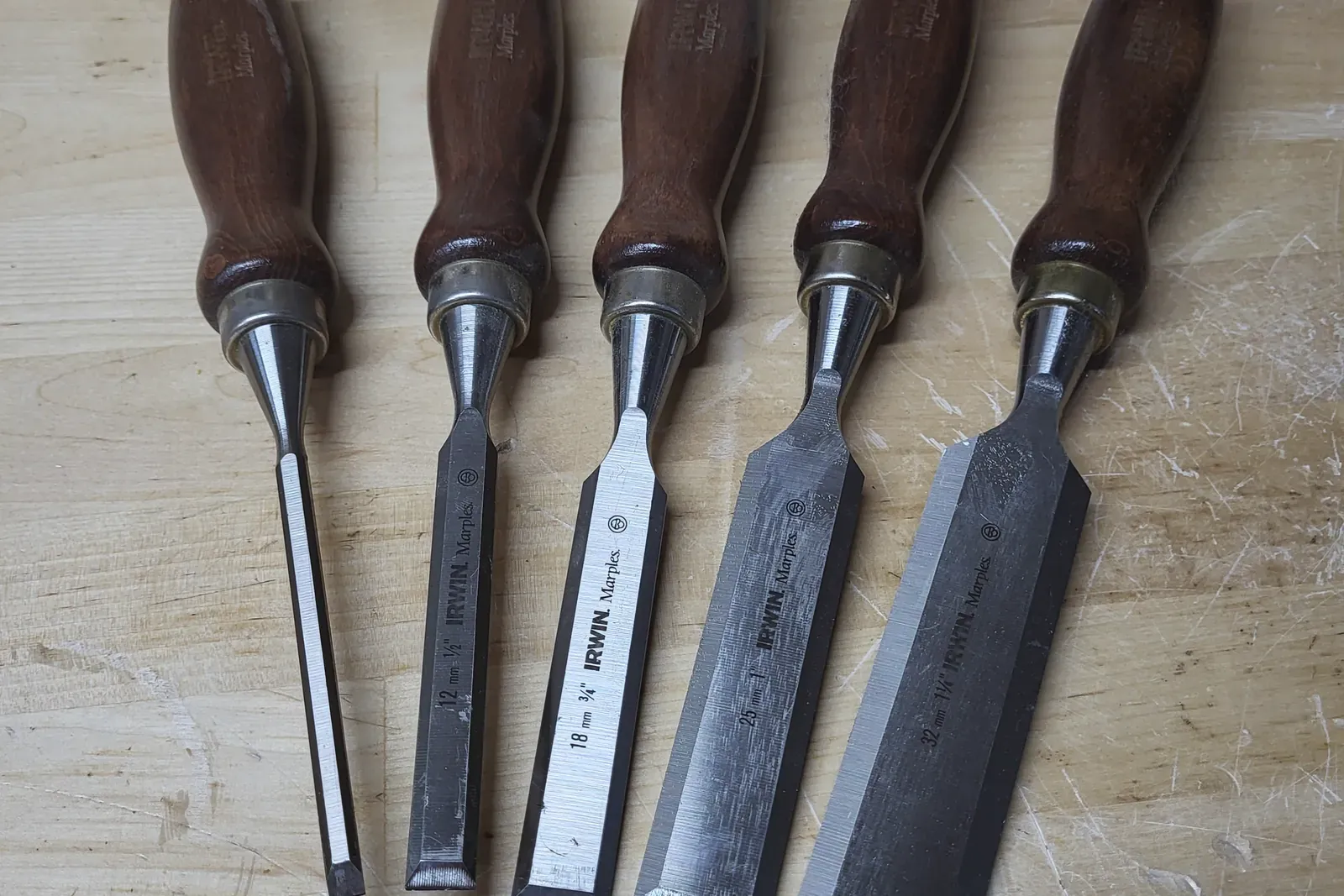
The photo is a fair box of used chisels. It is not a stone.
Which stone or plate to buy for this is in diamond plate or water stone.
Where this comes from
- Lie-Nielsen. Bevel-edge chisel instructions. Maker PDF. Lie-Nielsen Consulted 29 Oct 2026. back
- Lie-Nielsen. Sharpening instructions. Maker PDF. Lie-Nielsen Consulted 29 Oct 2026. back
- Paul Sellers. Setting up and sharpening a chisel. Teacher’s written method. Paul Sellers Consulted 29 Oct 2026. back
- Paul Sellers. One system fits all. Teacher’s note. Paul Sellers Consulted 29 Oct 2026. back
- Veta. How to choose a first chisel set. This notebook. Veta 29 Oct 2026. back
Changes in this guide
- First note. Buying a chisel is a different page.
Common questions
Is the bevel 25° or 30°?
Lie-Nielsen grinds their chisels at 30° and suggests a secondary bevel about 5° steeper. Sellers tells most narrow chisels to live at 30°, and also describes a freehand stroke that starts near 30° and eases toward 20–25°. They are not the same edge.
Have you done this?
No. Dull chisels are the dangerous ones, which is Lie-Nielsen’s warning, not a story from my bench.